Inner Mongolia leverages vegetable development
(chinadaily.com.cn)
Updated: 2014-08-29
Grafting makes for high output
Hohhot’s Qianbutaqi village is famous for its cucumbers, and many farmers are engaged in cucumber cultivation, with a plantation area approaching 1,000 mu. One may find it surprising to see so many cucumbers growing on pumpkin roots, which is a grating technique developed by the Inner Mongolia Academy of Agricultural and Animal Husbandry Sciences.
The academy introduced a new cucumber variety in 2013 to the village, and assigned Jia Linhui as a technical consultant for local plantation guidance.
Farmers fully experienced the grafting technique’s charm when they saw that the new cucumbers are superior in quality and output than previous varieties and generate more income.
“The grafting technique has produced significant results. It extends the picking period from three months to five and can increase annual output from 40,000 kilograms to 80,000 kilograms per mu,” said Jia.
In 2013, the central financial department helped promote 12 technologies on 18 agricultural products in Hohhot, Baotou, Erdos, Chifeng, Ulanqab and Bayannur. The core demonstration areas reached 311 mu, increasing annual income by 2.56 million yuan. They helped build surrounding vegetable facilities measuring 30,000 mu, which are expected to increase annual output value by 125 million yuan.
Slack vegetable supply to be redressed
Zhao Laihe, a businessman at Dongwayao farm and sideline products wholesale market, has a firm grasp of vegetable price movement.
“Tomatoes are sometimes sold at 8 yuan per kilogram in winter and 0.8 yuan in summer. The high price keeps the public from buying tomatoes, while the cheap price puts farmers out of business,” said Zhao.
Fu Xiaojie, an official of the Inner Mongolia commercial crop workstation, is no stranger to such price swings. “The year-round vegetable demand was 5.93 million tons in Inner Mongolia in 2012, while supply hit 14.76 million tons, an amount that could have fully met demand and export,” said Fu. However, the greenhouse vegetables went on the market from April to December, with non-greenhouse fresh vegetables arriving from July to October. Vegetables were only cultivated on an area of 400,000 mu for the winter supply, creating a dilemma where Inner Mongolia needed to sell 6.8 million tons of vegetables outside while importing 2.62 million tons in slack seasons, according to Fu. “The seasonal contradiction in vegetable supply is becoming a major problem that harms the public and farmers.”
Therefore, Inner Mongolia invested 140 million yuan in 2012 to solve the problem, including 125 million yuan on greenhouse vegetables. The Ministry of Agriculture unveiled guidance on vegetable and food project implementation in 2013. It also urged the enhancement of winter supply in major cities and counties in Northeast, North and Northwest China. Inner Mongolia plans to stabilize the vegetable plantation area at 6 million mu and output at 23 million tons, including 3 million mu for greenhouse vegetables and vegetable processing capacity reaching 4.3 million tons. It will focus on solving the winter supply problem.
Inner Mongolia will build a group of pollution-free, highly effective and standardized vegetable parks around Hohhot, Baotou, Erdos, Beijing and Tianjin to ensure supply, according to Jia Yuefeng, deputy director-general of Inner Mongolia’s Agricultural and Animal Husbandry Department.
Advantages of Inner Mongolia’s vegetable plantation
Inner Mongolia’s landform consists of mostly plateaus, with altitudes above 1,000 meters. It has a temperate zone continental monsoon climate, which gives rise to a cold ecological environment. Its area accounts for 70 percent of the total agricultural and animal husbandry production area. The cold environment helps grow high-quality and nutritious vegetables, and the high air volume and low humidity helps avoid the spread of pathogens and pests, making for pollution-free vegetables.
Wang Yong, director of the Inner Mongolia Academy of Agricultural and Animal Husbandry Sciences, said that the key is to solve a series of problems in vegetable production. Farmers should make a profit from planting vegetables, so the vegetable industry can enjoy healthy development, according to Wang. In addition, vegetable plantations should be large scale and based on market demand. Quality enterprises in seeds, mulching film, pesticide and fertilizer productions should be introduced to provide better service for vegetable production, said Wang.
Farmers have to grasp cutting-edge plantation technology so vegetable production can enjoy long-term development. Production should also be regulated by market, according to Wang.
“Inner Mongolia’s vegetables feature good quality, high nutrition and zero pollution. I think the idea of transforming the region into a pollution-free agricultural and animal products processing facility can greatly boost local vegetable production,” said Wang.
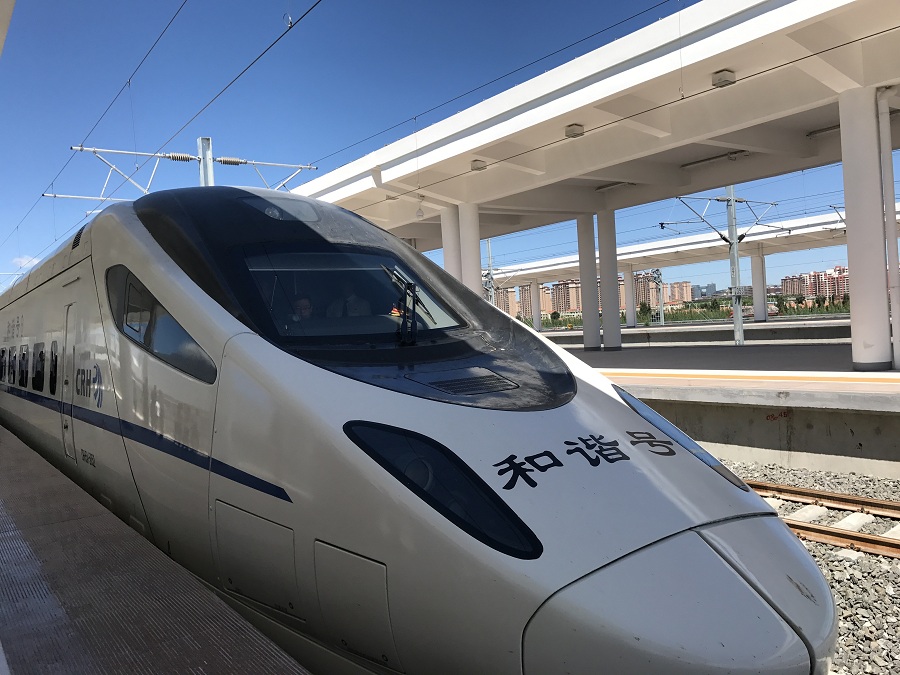
High-speed train debuts in Inner Mongolia
A bullet train departed Hohhot East Railway Station for Ulanqab marking the start of high-speed rail services using Inner Mongolia’s first newly-laid high-speed railway on Aug 3.