Writer finds lessons in prosperity from ancient Tea Road
By Zheng Yangpeng And Yuan Hui (China Daily)
Updated: 2014-08-22
It is a much less known commercial route than the Silk Road.
Few people now can imagine China's tea being transported to Mongolia and Russia by thousands of camels through the 10,000-plus-km Eurasian road.
A half-millennium later, camels have been replaced by trains, ships and aircraft. So what's the significance of this long-perished route?
In Chinese writer Deng Jiugang's eyes, the value of studying the rise and fall of this route goes far beyond satisfying a small group of history buffs.
It was a road of peace and reconciliation, of diversity and coexistence. It is a story of how trade makes everyone better off, Deng said.
In 1571, the Tumed Mongol leader Altan Khan successfully negotiated the end of the blockade by the Ming Dynasty (1368-1644) that had prevented access to China's iron, cotton and crop seeds. The result was peaceful trade between the Chinese and Mongols, and this made possible later China-Russia trade via the Mongolian Gobi.
In 1689, the two empires, Qing and Russian, decided to replace war with trade, and replace confrontation with dialogue. The result was the Treaty of Nerchinsk, which enabled bilateral trade to flourish.
From then until the early 20th century, the Russians sold furs, textiles and cattle, while the Chinese sold tea, porcelain, cloth and herbs. Numerous companies, Chinese and Russian, were set up to purchase and transport these goods, most famously by camel caravans.
At the road's peak, in the 18th century, Hohhot, now the capital of the Inner Mongolia autonomous region, was a linchpin that connected east-west and north-south trade.
About 200,000 camels passed through the city every year, each carrying about 180 kg of goods. The stores of trading companies from Russia, Britain, France, Switzerland and Japan competed with each other in Hohhot's downtown streets.
Deng, a 66-year-old Hohhot native and a prolific writer of both fiction and nonfiction, came across the historic crossroads in the 1980s.
At the time, he was writing a novel about Hohhot's history, and for that project, he interviewed hundreds of old merchants and laborers, then in their 80s and 90s.
He was so fascinated by the city's rich past that he decided to interview more people and complete a non-fiction work. That was Tea Road, which finally was published in 2000. He was the first person in China to study and name the historic road.
"All people died soon after I interviewed them. Without this, all those memories would be gone with their deaths," he said.
Regardless, he believes his interviews were too late. So many things are not documented, that "what we know about this road today is just a tiny part of what took place".
"This brings a lot of lessons for today. I wouldn't say I'm researching it. I'm learning from it," Deng said.
zhengyangpeng@chinadaily.com.cn
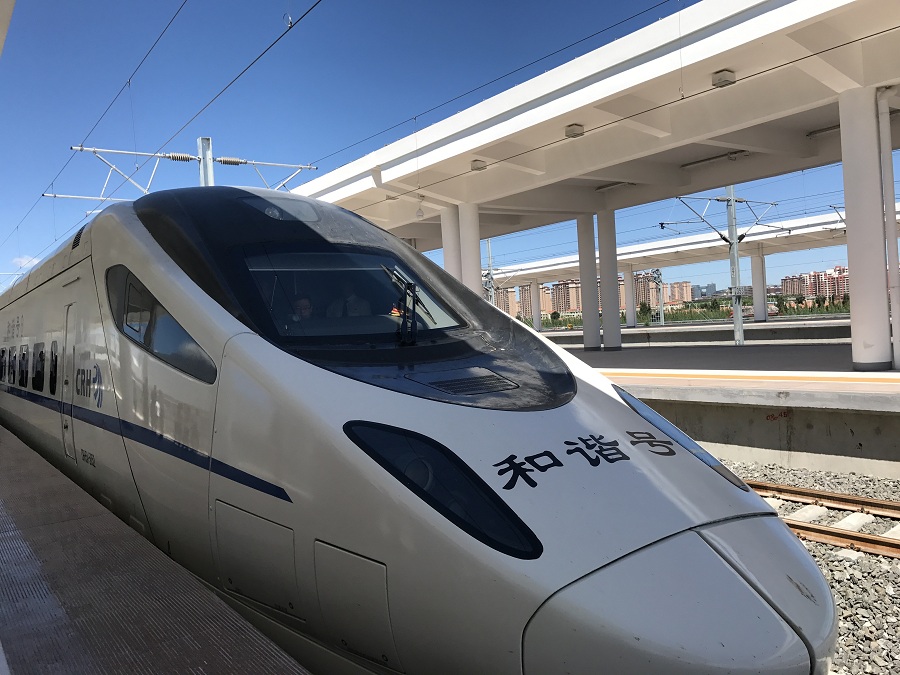
High-speed train debuts in Inner Mongolia
A bullet train departed Hohhot East Railway Station for Ulanqab marking the start of high-speed rail services using Inner Mongolia’s first newly-laid high-speed railway on Aug 3.