Hoomii
(chinaculture.org)
Updated: 2013-12-18
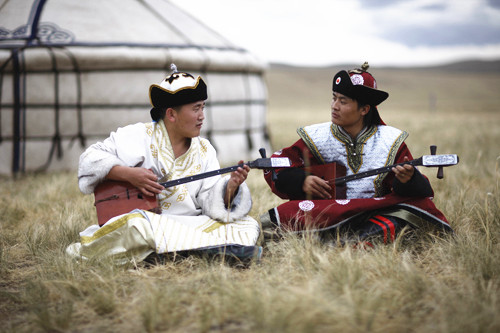 |
|
The Mongolian 'chor' is multi-part singing sung by just one person. Hoomii, in Mongolian, means larynx. |
Year: 2006
Sort: Folk Music
Area:Inner Mongolia Autonomous Region
Serial No.: Ⅱ-4
Declarer: Inner Mongolia Autonomous Region
For one person to simultaneously make two sounds up to six octaves in difference simulating the sounds of pouring waterfalls, winds on the grassland, and the cries of animals would seem an incredible feat. But Mongolians have such a way of singing, called 'Hoomii' or throat-singing.
The method of singing Hoomii, in Mongolian, is called 'chor'. Interestingly, 'chorus' in English, 'chord' in French, and 'chor' in German, all refer to the same thing: multi-part singing. The Mongolian 'chor' is multi-part singing sung by just one person. Hoomii, in Mongolian, means larynx. With more than 800 years of history and three different genres -- the overtone, the quaver, and the complex -- the Hoomii is surely more than an outstanding vocal mimicry. The basic structure of Hoomii is consists of a continuous bass and a musical treble. Singing the Hoomii, one needs to use the vocal cords, the nasal and oral cavities, and even the thorax to vibrate the current of air to flow between the three. Sometimes, a Hoomii singer can even create consonances without using the vocal cords. It is said that Hoomii is not to be sung with larynx, but with air currents.
One of the most famous Hoomii singers is Wen Li, who is the only female Hoomii singer in Chinese and Mongolian history, since Hoomii had always been a folk art which only males were allowed to learn. However, Wen Li can produce four voice parts and there are eight frequencies in her voice. It is said that not only talent and hard work are necessary to learn Hoomii, there is also a certain kind of physical standard the singers must have - Wen Li is the combination of all. In her words, "I might have the soul for it".
For the past 100 years, the Hoomii was once lost on the vast Inner Mongolian Plateau. Even today, the number of Hoomii singers is less than 100 throughout the nation. For the protection as well as the development of the legendary folk art, the Hoomii singers are considering whether to add in some modern music, for example, rock. However, as ancestors of the Mongolians said, "chor can only be sung where it is quiet, where you can hear the nature, the birds and the leaves dancing. Once the soul is there, you can begin the chor."

High-speed train debuts in Inner Mongolia
A bullet train departed Hohhot East Railway Station for Ulanqab marking the start of high-speed rail services using Inner Mongolia’s first newly-laid high-speed railway on Aug 3.