The road once taken
By Cui Jia (China Daily)
Updated: 2013-10-29
 |
|
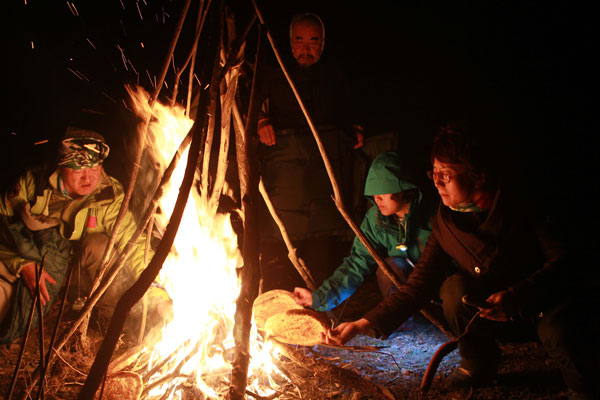
Members of the Xibe ethnic group cook at a bonfire on the banks of the Kherlen River in Mongolia as they journey from Liaoning province to the far west of China. [Photo by Cui Meng / China Daily] |
Editor's note: This is the 10th in a regular series of reports brought together under the banner "Lost Horizons", which aim to show life in the less-reported areas of the country and to give a voice to those whose words often go unheard. Slideshows and video footage are also available at www.hwdly.com.cn/video
Soldiers' descendants revisit route their ancestors traveled 250 years ago to defend the nation, Cui Jia reports from Xinjiang and Mongolia
Fu Shihao ran around his grandfather's courtyard proudly displaying a yellow "honor belt", which he had to wrap twice around his tiny waist just to keep in place.
The belt is the property of the 5-year-old's aunt, who lives in the Qapqal Xibe autonomous county in the Xinjiang Uygur autonomous region.
She is one of eight members of the Xibe ethnic group awarded the honor after retracing a journey made by their ancestors almost 250 years ago.
 |
|
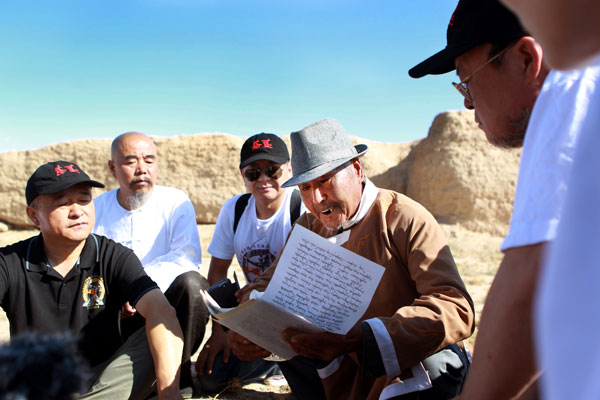
An elderly man from the Xibe ethnic group relates a story in the local language. |

On the belt buckle is carved the image of a mythical creature whose Xibe name has been lost through the generations. It has a body shaped like a horse, but its features are closer to those of a lion or dog, and it has wings and a unicorn's horn.
The animal was once revered by the Xibe people, who told of how it saved their forefathers by guiding them safely out of a deep forest when they were lost.
Most of the Xibe living in Northeast China, where the creature worked its magic, have adopted the lifestyle of the Han ethnic group, losing their traditions in the process, so only a few Xibe people recognize the animal.
However, it would have been familiar to the more than 1,000 Xibe soldiers and their 3,000 relatives who were dispatched to Xinjiang in 1764 to guard the nation's borders.
Bei Xian Na ("Hello" in the Xibe language), said little Shihao, as he left off careering around the courtyard to greet his honored aunt, Xue Mei. Nowadays, the Xibe language is only spoken in Qapqal, which is home to approximately 20,000 Xibe people, roughly 12 percent of the ethnic group's total population in China.
Xue, 43, who works for a large State-owned enterprise in Beijing, had arrived just in time for a family lunch at the house in which she was raised. Along with traditional Xibe pancakes, Xue's father, Fu Zhangyong, 74, offered his daughter Kazak milk tea, a favorite drink among the Xibe who have lived alongside members of the Kazak ethnic group for centuries. The rich grasslands of Qapqal, in Ily Kazak autonomous prefecture, provide a natural home for the nomadic Kazaks.
Little did the family know, but Xue had a surprise for her father, a 10th-generation descendant of the soldiers whose deployment was specifically requested by an Ily-based Qing Dynasty General, Mingrui.

High-speed train debuts in Inner Mongolia
A bullet train departed Hohhot East Railway Station for Ulanqab marking the start of high-speed rail services using Inner Mongolia’s first newly-laid high-speed railway on Aug 3.