More public infrastructure projects to "Go West"
(Xinhua)
Updated: 2013-10-24
BEIJING, Oct. 22 (Xinhua) -- A State Council report on Tuesday said that more government investment will go to large infrastructure projects in west China.
The central government will help western provinces expand railway networks, build arterial highways, upgrade state and provincial highways as well as build new reservoirs, said the report by the National Development and Reform Commission, China's top economic planner.
"We will try to solve the problems of road and water supplies that people in the west complain most about," said Xu Shaoshi, head of the commission.
The density of highway and railway networks in the western region is about half the national level. Despite fast economic growth in recent years, the west still lags behind especially in infrastructure and environmental protection.
A number of cities have transport difficulties. It takes about nine hours by train to cover 400-km between Chifeng in Inner Mongolia and Beijing while the high-speed train takes only half an hour from Beijing to Tianjin, about 140 km away. Investment in transport infrastructure will help forge an international corridor between China, Southeast Asia and Central Asian countries, Xu said. Investment will continue in oil pipelines linking China with its western neighbors.
In 2001, China began the western development program, known as the "Go West" strategy, and it covers 12 municipalities, provinces and autonomous regions, including Chongqing, Gansu, Inner Mongolia, Tibet and Xinjiang. In 13 years, central government has sent about 8.5 trillion yuan (1.4 trillion U.S. dollars) from the central treasury to the western region. About 40 percent of central investment has gone to the west and funded 187 major infrastructure projects, including the landmark Qinghai-Tibet railway.
The region enjoys preferential policies in tax, land use and human resources. Companies relocating there enjoy flexibility and corporation tax of 15 percent instead of the usual 25 percent.
The region's gross domestic product (GDP) increased from 1.58 trillion yuan in 1999 to 11.39 trillion yuan in 2012, and contributed 19.8 percent of China's total GDP in 2012, up from 17.9 percent in 1999.
Major economic indices of western provinces have been higher than eastern provinces and the national average since 2007. The annual income of urban residents increased from 5,302 yuan in 1999 to 20,600 yuan in 2012 while rural incomes were up from 1,634 yuan to 6,027 yuan.
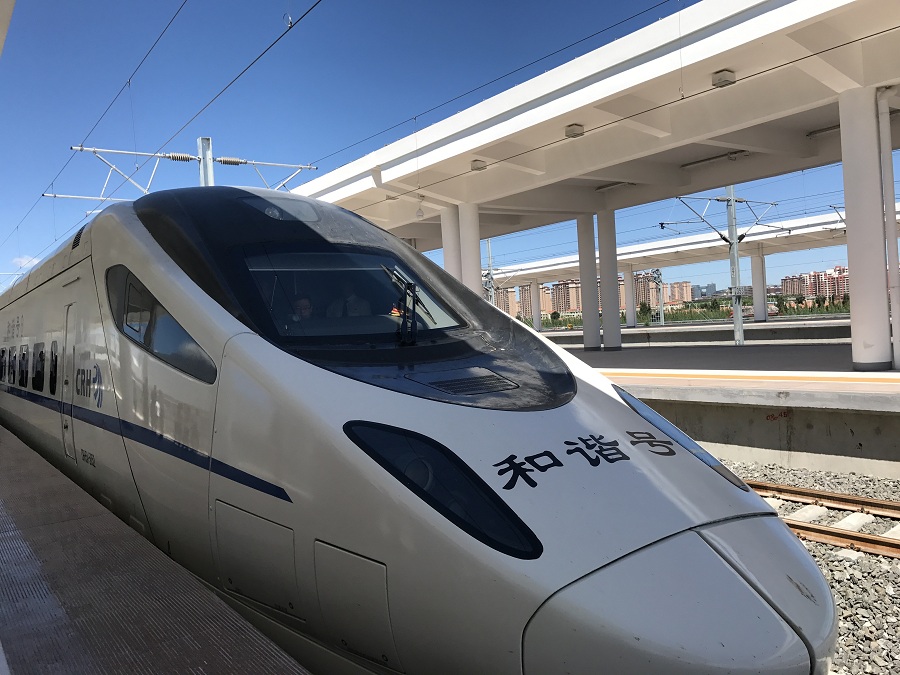
High-speed train debuts in Inner Mongolia
A bullet train departed Hohhot East Railway Station for Ulanqab marking the start of high-speed rail services using Inner Mongolia’s first newly-laid high-speed railway on Aug 3.