Making the deserts bloom
By Wu Ni (China Daily)
Updated: 2013-07-30
 |
|
Photo Provided to China Daily |
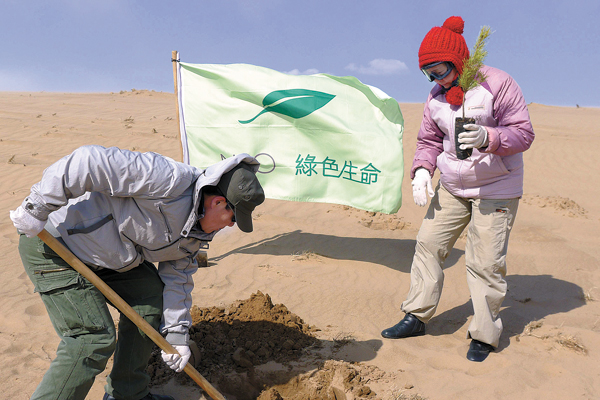
"Sand is everywhere," she says of her first impression of the county. "Even when I lay in bed, I could catch a handful of sand trickling through my fingers."
But the worse thing was the toilet. "The excrement was dried and piled up in the pits," she says. "That's understandable - who would waste water flushing the toilet when you barely have enough water to drink?"
However, 60 years ago, the county had lush grassland and plenty of water. Unrestrained deforestation turned the land barren and it was gradually eroded by desert.
Yi's project was to spend 10 years planting 1.1 million trees on the 10,000 mu (667 hectares) of sandy soil, equal to about 960 football fields. Local villagers were hired to plant trees and protect the saplings. After the trees have grown for 20 years, they will donate the trees to the villagers.
Yi has also planted many trees herself. The elegant city woman who used to bathe twice a day and always have fresh flowers in her home, now spends much of her time in the desert, often in sandstorms and battling extreme temperatures.
Zhang Haitao, a young musician in Beijing, became a Greenlife volunteer in 2011. "First it was Yi's story that touched me. When I actually went to the desert, I learned much about environmental protection from her, which I did not care about before."
Yi says dramatic changes have occurred in Hure Banner.
"Some of its sandy soil has turned back into grassland. Villagers can grow watermelons on it. And the local river used to be dry to the bottom, now it has fish to catch."
Determined to recreate the miracle in other deserts, Yi started her second project in Dengkou county in western Inner Mongolia, aiming to plant 667 hectares of sacsaoul trees in the Ulan Buh desert. They have so far planted 133 hectares, with a survival rate of over 85 percent.
The success has brought her numerous honors. At Greenlife's headquarters in Shanghai's Hongkou district, a large glass cabinet showcases dozens of honor certificates she has won, such as the Seventh China Charity Award in 2012, Outstanding Female Role Models in 2011 and National Afforestation Medal in 2010, to name just a few.
All the honors, however, do not really matter to her, Yi says, but they are important for Greenlife because the fame can help the organization attract more donations.
Climate change, growing population and economic development are the main causes of land degradation, making China one of the countries most seriously affected by land degradation in the world
Some 400 million Chinese people's livelihoods are affected by desertification, which affects up to 27.46 percent of the total land area, says Sun Zhagen, deputy chief of the Chinese Forestry Administration in a forum in May.
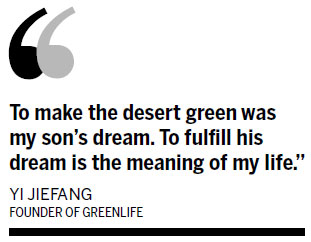
"Just take away all this fame or fortune, and give my son back to me, that's all I would ask," Yi says, "but reality is so cruel. My son won't be back. Devoting myself to the plantation gave me some psychological comfort - had my son seen the forests, he would have felt happy."
Xi Yanling, 60, from Beijing, also lost a child and has found comfort working for Greenlife. Xi's daughter, who also loved nature, died of cancer when she was in university. The grieving mother found planting trees a good way to work through her sorrow.
She joined Greenlife in 2010 and became a core member of the group.
"When we lost our children, besides sadness, we felt lost because our love did not have a focus. By planting trees and improving environment, we feel our love is extended as it is for all children's benefit. In this sense, I think Yi is a great mother," Xi says.
For Yi and Xi, the most valuable legacy for their children is planting trees.
"In China, parents save money for their children. They buy big houses and luxury cars for them. But ultimately, it is the good environment, the clean air and safe water that will improve their lives," Yi says.
See more China Face, here
High-speed train debuts in Inner Mongolia
A bullet train departed Hohhot East Railway Station for Ulanqab marking the start of high-speed rail services using Inner Mongolia’s first newly-laid high-speed railway on Aug 3.