 |
About Hubei |  |
Culture & Arts |
 |
Attractions |  |
Routes |
 |
Dining |  |
Shopping |
 |
Hotels |  |
Transportation |
 |
Entertainment |  |
Travel agencies |
Jingshan to attract Wuhan tourists
Storytelling queen
For the love of Wuhan
Dangyang to promote tourism


Moving monitoring stations undermines figures: report
By Wang Qian (China Daily USA)
Updated: 2013-10-22
China's rapid urbanization forced the relocation of many weather monitoring stations in past decades, threatening the consistency and accuracy of the monitoring data, a National People's Congress report said on Monday.
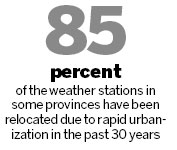
In some provinces, 85 percent of the weather stations have moved in the past 30 years, with 11 percent of the stations in these regions moving four times, the report said without naming the provinces.
Ji Bingxuan, vice-chairman of the Standing Committee of the National People's Congress, said the difficulties in protecting weather monitoring instruments and the environment are increasing with rapid urbanization.
One meteorologist said relocating weather stations may affect the accuracy of weather reports because the reports are based on the analysis of consistent meteorological data over decades.
If a coastal weather monitoring station is surrounded by tall buildings, it may not be able to detect strong winds, causing the economic losses, said Chen Ling, a forecaster at Fujian provincial meteorological bureau.
Statistics from the Hainan Meteorological Bureau show the ground environment at 70 percent of the province's weather stations has been damaged, threatening the accuracy of forecasts and timely weather alerts.
In Hubei, nearly 40 percent of the province's weather monitoring stations have been relocated because of environmental damage or construction projects, said Cui Jiangxue, director of the provincial meteorological bureau.
"Relocating weather monitoring stations out of downtown areas can also affect the monitoring of temperatures and humidity in these areas," Cui said, suggesting that urban planners should consider the location of these stations.
A regulation on the environmental protection of weather monitoring equipment, introduced on Dec 1, states that the relocation of weather stations should be approved by local meteorological bureaus.
Figures from the China Meteorological Administration last year show there were more than 2,500 weather monitoring stations nationwide.
The report also said investment in weather monitoring, especially in western China and border regions, should be increased because natural hazards are becoming more frequent.
From 2000 to 2013, the central government allocated more than 80 billion yuan ($13 billion) to public weather services, with an annual increase of 15 percent.
Xu Xiaofeng, deputy director of the China Meteorological Administration, said: "Development of the meteorological industry cannot meet the soaring demand brought by rapid economic development.
"Fast economic development requires improved weather forecasts and warnings, which need large investment in the country's weather monitoring infrastructure."
Xu said personnel training is equally important.
From 2013 to 2015, the administration plans to train more than 2,000 directors of country-level meteorological bureaus in weather services and disaster prevention and mitigation.
Zhao Yinan contributed to this story.