 |
About Hubei |  |
Culture & Arts |
 |
Attractions |  |
Routes |
 |
Dining |  |
Shopping |
 |
Hotels |  |
Transportation |
 |
Entertainment |  |
Travel agencies |
Jingshan to attract Wuhan tourists
Storytelling queen
For the love of Wuhan
Dangyang to promote tourism


Nurses embark on journey to the West
By Yang Wanli reports in Hamburg and Tang Yue in Beijing (China Daily)
Updated: 2013-09-25
|
 |
|
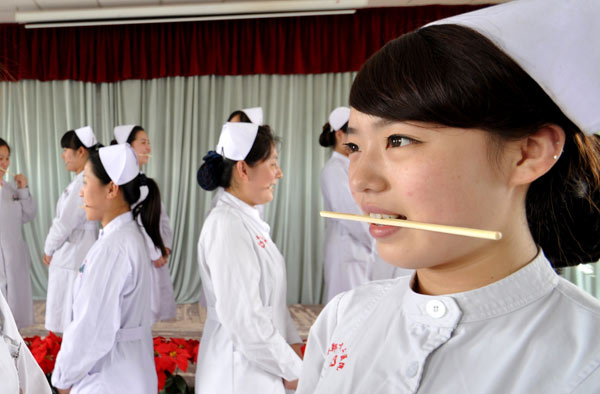
Nurses receive training at a hospital in Handan, Hebei province. Some Chinese nurses have migrated after working overseas. HAO QUNYING / FOR CHINA DAILY |
|
Valuable lesson in Singapore Liu Xiaojing, 33, from Shandong province, who worked as a registered nurse in Singapore for 18 months from 2010, says she was impressed by the city state's strict working rules for nurses. At the KK Women's and Children's Hospital, where she worked, Liu was once harshly criticized after she gave a patient pills two hours before the time stated. "Such cases are easily ignored in China's hospitals, where giving pills earlier or later doesn't matter too much," she said. But in Singapore, her mistake resulted in harsh punishment. She was asked to write a long report on the case and to apologize. "After returning to China, this case always serves to remind me to treat every patient more carefully and seriously," Liu said. She also said that doctors in Singapore can clearly remember every detail about the health of their patients. The doctors spend more time with their patients, rather than preparing for a variety of tests for career promotion, Liu said. "In Singapore, medical staff members treat patients well. In return, patients give them more respect," she said. "In China, it is the opposite." In Singapore, about 40 nurses serve every 30 patients, while in China three patients share one nurse. "Low pay and less respect from patients really affects Chinese nurses," Liu said. "I would encourage more young nurses to work overseas for a time. Such experience means far more than just learning, but also acquiring a more positive attitude toward the job. These nurses will gain a stronger awareness of professional ethics and their responsibilities." - Yang Wanli and Tang Yue |
Relations between medical staff and patients have been severely strained in China over the past years. Without competition from privately owned hospitals, public hospitals take almost all the responsibility for patients' medical services. Patients have not been happy with hospital services, while doctors have complained of low salaries.
"In some other countries, nurses enjoy more respect and hospitals place greater value on their services. It is also the dream of many young people to see the outside world," Wang said.
He added that some Chinese nurses have migrated after working overseas for several years, while others found better jobs after returning to China.
The nurses' training center in Shandong province is owned by an overseas personnel-training company, formed in 1989. To date, more than 80,000 Chinese have been trained and sent overseas through the center. Previously, most of the workers were blue-collar employees, such as welders and farm workers. Now, demand has grown overseas for more skilled workers from China, including nurses.
Since the training center was set up in 2005, more than 1,000 Chinese nurses have been sent abroad, mostly to Asian countries, including Singapore and Japan, which have a shortage of nurses along with an aging problem.
"The consequences of this immigration will be mainly positive," said Schmutzler, the press official with the German Federal Employment Agency.
He believes such immigration will increase, because the labor force in Germany will decline in coming decades as the number of elderly people increases.
"Neither immigration from European Union countries, nor from non-EU countries, may be able to fill this gap alone. Only a mixture of both, plus domestic measures to activate hidden potentials in the German labor market, will help to meet this challenge successfully," he said.
Wagner, from the German Nurses Association, said, "In the short term, we will be able to cover vacancies with German nurses if employers create better working conditions."
He said thousands of German nurses have left the profession, unwilling to cope any longer with the workload and other factors. "If more nurses from abroad come to Germany, I assume many will move on to other countries in Europe where they will find better jobs," he added.
Personal choice
Working overseas is a personal choice for Song, of concern only to her family and boyfriend.
"Many single girls might be encouraged to marry Germans, who are known for their good looks as well as an attitude centered on the family," she said. "But I've got a Chinese boyfriend. He will not come with me, but our relationship will be sustained by our trust and love."
She has many images of Germany in her mind, including its dress sense, gentle attitude and numerous types of beer and sausages. Most of her impressions stem from books or TV programs, with Munich being Song's favorite city "because of local people's hospitality".
Song said that with her hometown known for its spicy food, one essential item she must take with her to Germany is a large bottle of local chilies.
Contact the writers at yangwanli@chinadaily.com.cn and tangyue@chinadaily.com.cn
Wu Wencong in Beijing contributed to this story.