 |
About Hubei |  |
Culture & Arts |
 |
Attractions |  |
Routes |
 |
Dining |  |
Shopping |
 |
Hotels |  |
Transportation |
 |
Entertainment |  |
Travel agencies |
Jingshan to attract Wuhan tourists
Storytelling queen
For the love of Wuhan
Dangyang to promote tourism


The road to life after education
By Shi Jing and He Wei (China Daily)
Updated: 2013-09-23
 |
|
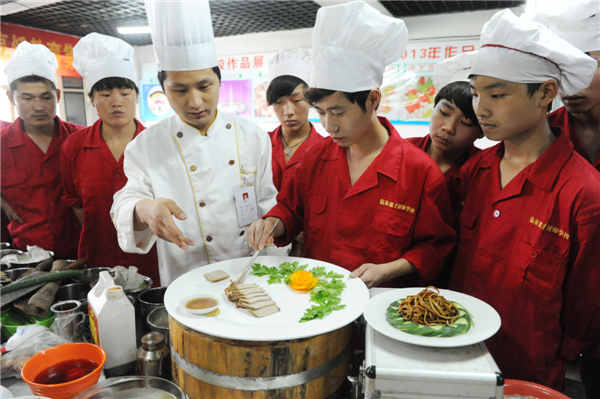
Students learn how to make chinese cold dishes at a privately owned vocational school for chefs in Fuyang, Anhui province. Wang Biao/For China Daily |
"This will do much good for the upgrading and restructuring of the manufacturing industry," he said.
To ensure graduates meet the demands of companies, Chien-Shiung places higher requirements on its teachers. They must have the required teaching qualifications and also be experienced technicians. At present, about one-tenth of Chien-Shiung's teachers have worked overseas.
Of Chien-Shiung's first 17 graduates under the dual education system, half have become technical directors with their companies. Wang Fang, one of them, was promoted from technical worker to workshop director after two years with Schaeffler Holding (China) in Taicang.
"I think graduates from Chien-Shiung are more promising in terms of career development," she said.
Wang Bo graduated from Chien-Shiung last year. Although he received job offers from German companies, he chose to return to his father's firm in Suzhou, which has made electric converters for more than 40 years.
"I chose to study at Chien-Shiung especially because I am a huge fan of machines and large equipment. I am not too much of an academic person. What I have learned at school can be really useful in my father's factory," he said.
Wang Yonglin, a standing committee member of the Taicang City Committee of the Communist Party of China, says vocational education in the city should become the template for the nation.
While many people still think vocational school graduates are those unable to get enrolled at universities, this perception has changed in Taicang. More than 50 percent of the junior high school graduates choose to go to vocational schooling, while less than 50 percent go to high schools.
Young people in Taicang are willing to go to vocational schools largely because there is no barrier between these schools and colleges. About 10 percent of the technical secondary school graduates will continue to pursue their studies at colleges. The local education authorities have also cooperated with Tongji University in Shanghai so that students can complete their education at a higher level.
Wang said: "Vocational education does not indicate an end period - as can be seen in Germany. We should bring the same system here to China so that students will be more willing to go to vocational schools. The ultimate goal of pursuing whatever kind of study is to ensure employment, which vocational education in Taicang can do."