 |
About Hubei |  |
Culture & Arts |
 |
Attractions |  |
Routes |
 |
Dining |  |
Shopping |
 |
Hotels |  |
Transportation |
 |
Entertainment |  |
Travel agencies |
Jingshan to attract Wuhan tourists
Storytelling queen
For the love of Wuhan
Dangyang to promote tourism


Giant sinkholes plague Hubei mining region
By Liu Kun in Jingmen, Hubei and Zhou Wenting in Shanghai (China Daily)
Updated: 2013-09-23
People in Xinqiao know only too well the dangers of sinkholes.
Yang Lixiang has been lucky to survive two that opened up at her farm this summer.
"I was picking cotton and suddenly the ground just broke up - I fell into the crack, head to toe," she said, recalling an incident on Aug 20. "Luckily, I was able to grab a cotton stalk and pull myself to safety."
Three days later, a second sinkhole reduced her home to rubble, with Yang and her husband inside, showering them with bricks.
Yang's farm now contains a crevice 200 meters in diameter and 19 meters deep, and the couple are living in a school in a neighboring county.
The couple's experience is not an isolated one. The village of Xinqiao, on the outskirts of Jingmen, Hubei province, has experienced many such cases of subsidence in recent years, attributed by experts to gypsum mining in the area.
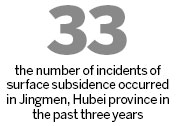
At least 33 incidents of surface subsidence, covering a total area of 380,000 square meters, have occurred due to gypsum mining in Jingmen in the past three years, according to the local government.
The city's downtown Dongbao district, which is rich in gypsum deposits, has been particularly affected. Gypsum - a mineral used to make plaster and fertilizer, among other things - has been mined intensively, and has been a major contributor to the local economy. However, since 2008, when the first sinkholes began to appear, locals say they have lived in fear of being swallowed by the ground.
Among them is Ye Guangxiang, who said her family has slept in a makeshift tent outside since 2008. The nearest sinkhole was just 75 meters from her home.
"Every night my 4-year-old grandson cries because he worries about the subsidence," she said, adding that her son and daughter-in-law work away from home.
The road between Xinqiao and Zengmiao looks like it has been struck by a violent earthquake. A 1-meter crevice runs through it, while many of the surrounding hills have been turned into depressions and houses have collapsed.
Mining practices
Gypsum mining in the area dates back to the Qing Dynasty (1644-1911), although large-scale mine construction did not begin until 1970.
According to Jingmen's land resources bureau, the practice presents a danger when mining companies fail to fill mines with rubble once they have been closed. While in use, mines are supported by the so-called room-and-pillar method, by which a certain layer of gypsum is left in place to act as a roof supported by pillars.
However, once a mine falls into disuse, it fills with water, which can weaken the supporting pillars, leaving the mine susceptible to collapse.
China Daily visited a working mine about 110 meters underground in Macheng, a town in Duodao, to see the room-and-pillar method in action.
Liu Xiaoming, the district's section chief for mine management, explained the problem.
"If no filling is done (after the mine has been closed), water accumulates and the pillars become waterlogged, which results in the collapse of the pillars and ground subsidence."
Filling a mine costs between 10 yuan and 20 yuan ($1.63 and $3.27) per cubic meter, but mining companies rarely include this cost in their budgets, he said.
Su Yongqing, head of the Xinqiao village committee, confirmed that the sinkholes became more frequent after many mines were closed in 2009. Sixteen cases of ground settlement have occurred in Dongbao and 17 in Duodao district.
Government action
Many farmers have been resettled by the local government due to the frequent subsidence and the deterioration of the environment, which has in turn affected agricultural production.
Sixty-three households have moved out of Zilingpu, which is now almost deserted. Only eight households stayed on because of insufficient compensation provided for relocation. They said they would not be able to support themselves without income from farming their land.
Local authorities say they are working on tackling the issue, attempting to enforce good practice in those mining operations that continue, while encouraging the filling of mines once they are closed.
Wang Yuchuan from Jingmen's land and resources bureau said, "Several gypsum mining areas are facing a difficult time due to restructuring, and the authority is strengthening their management, including standardizing pillars and refilling with the waste materials."
However, he conceded, it is "almost impossible" to bring all the mines under control.
According to the local government, all gypsum mines in the area are required to close by the end of 2015. The mining areas in Dongbao and Duodao, meanwhile, are part of an urban planning area and are earmarked for development.
Contact the writers at liukun@chinadaily.com.cn and zhouwenting@chinadaily.com.cn
|
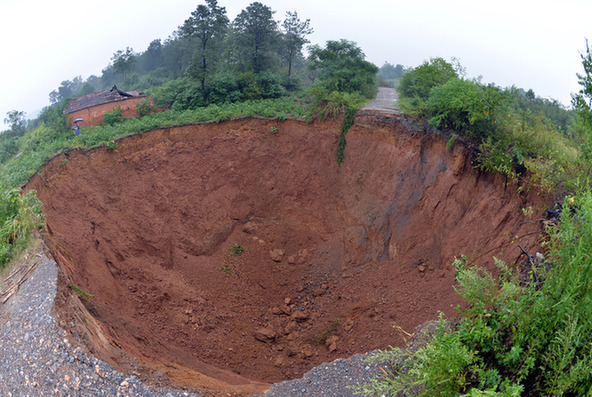 A sinkhole in Jingmen, Hubei province, is one of at least 33 incidents of surface subsidence in the city, which cover a total area of 380,000 square meters, according to the local government. Xiong Bo / for China Daily |