 |
About Hubei |  |
Culture & Arts |
 |
Attractions |  |
Routes |
 |
Dining |  |
Shopping |
 |
Hotels |  |
Transportation |
 |
Entertainment |  |
Travel agencies |
Jingshan to attract Wuhan tourists
Storytelling queen
For the love of Wuhan
Dangyang to promote tourism


Zigui, hometown of Qu Yuan
(chinatravel.com, chinaculture.org)
Updated: 2011-12-01
Qu Yuan
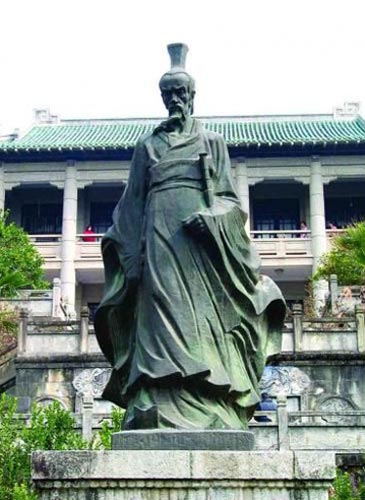 |
| The statue of Qu Yuan |
Qu Yuan was a great politician and poet in the Warring States Period (476-221 BC). He was born in an aristocratic family of the Chu State, one of seven powerful states at that time. His birthplace is today's Zigui county in Hubei province.
Fully trusted by the king of the Chu State, Qu Yuan served as the chief assistant to the king. Representing progressive forces he had advocated and upheld the idea of political reforms. He carried out political reforms, set up strict legal system, and gave full opportunity to the able, all of which met with strong opposition of the decadent aristocrats.
Menaced by the threat of the Qin State, Qu Yuan advocated the alliance with other states, fighting against Qin with a combined force. The ruler of the Qin, who viewed the Chu State as the number one adversary, schemed to undermine the good administration of Chu under Qu Yuan. He sent his men to bribe the brother and favorite woman of the king of Chu, who were jealous of the authority of Qu Yuan. The two spoke ill of Qu Yuan to the king and the king took it for truth at last. Qu Yuan was exiled eventually.
In the course of his banishment, unhappy and dejected, Qu Yuan wandered the countryside and produced a great many poets, expressing his love for the country and its people, his concerns about the country and his detestation toward the treacherous persons. On the breakthrough of the Qin army into the capital of his country, Qu Yuan threw himself into Miluo River in present Hunan Province and died with his country. At the news of his suicide, the Chu people, who held him in high reverence for his integrity and nobleness, rushed out in their boats to rescue him by boats, but failed even to find his body. To prevent his body from being eaten by fish they beat the waters furiously with their paddles and dropped rice dumplings wrapped in silk into the river.
In memory of this great patriotic poet, people made it a custom that on the day of his death, the fifth day of every fifth lunar month, a dragon boat race would be held and people should eat Zongzi, which is the glutinous rice ball wrapped up with bamboo or reed leaves. The tradition is still kept up to now, called the Dragon Boat Festival.
Qu Yuan (340-278 BC) was the first great patriotic poet in the history of Chinese literature. He composed 25 poems including Sorrow after Departure, The Nine Songs(11 pieces), Asking Heaven, The Nine Elegies (9 pieces), The Far-off Journey Divination, and The Fisherman.
Sorrow after Departure is Qu Yuan's classic work, which is also the earliest long lyric poem in China. The poem resolutely uncloaks the repulsiveness of the ruling class by deploying a series of metaphors, and at the same time portrays some upstanding models who adhere to justice, are unafraid of persecution and very devoted to their country and people. Sorrow after Departure is a romantic lyric poem with a measured realism. The form of Sorrow after Departure comes from its origins in local oral traditions and its very concise language echoes the many dialects of the Chu State.