 |
About Hubei |  |
Culture & Arts |
 |
Attractions |  |
Routes |
 |
Dining |  |
Shopping |
 |
Hotels |  |
Transportation |
 |
Entertainment |  |
Travel agencies |
Jingshan to attract Wuhan tourists
Storytelling queen
For the love of Wuhan
Dangyang to promote tourism


Xiaogan
(travelchinaguide.com, China Knowledge, chinatravel.com, wikipedia)
Updated: 2011-11-21
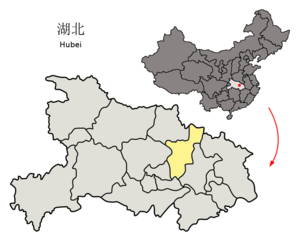
Xiaogan is located in north-central Hubei province, on the south bank of the Hanjiang River and neighboring Henan province in the north. Xiaogan in Chinese means filial piety and pity; the name was derived from a legend, which has it that a man named Dong Yong sold himself to pay for his father’s burial and a god took pity on him for his filial deed. The city was named Xiaochang in AD 454 during the Song Dynasty and its name was changed into Xiaogan in AD 924 during the Five Dynasties and Ten Kingdoms Period.
Xiaogan is an origin place of Chu Culture, which is an important part of Chinese Culture. Over 460 historical sites are well-preserved in the city.
 |
|
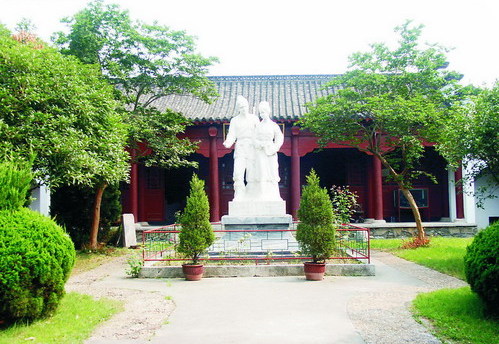
The hometown of Dong Yong, whose legend gave birth to the name of Xiaogan. |
Besides, the colorful ancient culture of Xiaogan can be learned from those bamboo slips of Qin dynasty, lacquer wares of Qin and Han dynasties, national treasure and cultural relic of Eastern Han like earthenware buildings and the site of the city in which the king of Chu lived. The traditional cultural art here such as paper-cut, leather-silhouette, paste-mould are of long standing.
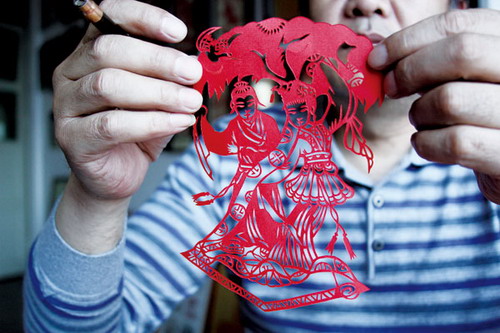 |
| Paper-cut, a traditional cultural art in Xiaogan city |
In extremely long ago, cities and counties of present Xiaogan belonged to ancient Jingzhou. During the Zhou Dynasty (11th century BC - 221 BC), this region was the capital of several city states. Danyang is the old name of Xiaogan. It was changed to a regional level district under Hubei province in 1961.
According to the landform, the city can be divided into three major parts. The northwest of the city is mountainous area. The northeastern area is occupied by low mountains and hills. Plains are mainly distributed in the south of Xiaogan. There are four rivers in the city with several lakes scattered.
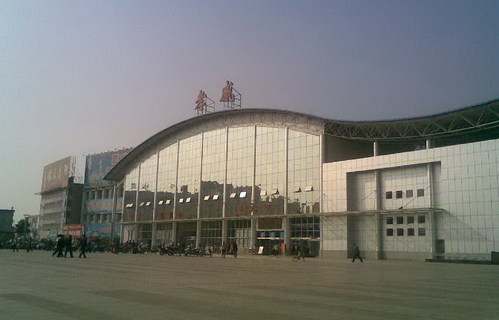 |
| Xiaogan Railway Station |
Water resources and minerals are abundant both on the earth surface and underground in Xiaogan area. Salt, phosphorus and paste are called “the Three Treasures of Xiaogan”, so Xiaogan has long been called “Capital of Paste”, “Sea of Salt”, “Mountain of Phosphorus”. Xiaogan , abundant in agricultural resources, is the base of national products like grain, cotton oil and rare aquatic product and thus has long been regarded as “A Land of Fish and Rice”.
Bearing a subtropical monsoon climate, Xiaogan has clear four seasons, but chilly and torrid periods are short. The annual average temperature is 16℃ (61℉). Weather in spring, autumn and early summer is moderate. Mid-June to mid-July is the plum rain season, and rainstorms usually occur during this period. Xiaogan's winter is cold and seldom rainy or snowy. Thus for tourists, it will be comfortable to visit the city in spring, autumn and early summer.
Xiaogan is also rich in tourist resources, which has been granted with five national forest parks: three ponds in Dagui, three passes (Wusheng, Pingjing and Jiuli) in northern Chu, Spring of the Jade Maiden Pond, Double-peak Mountain and Baizhao Mountain (The poet-immortal Li Bai once lived in seclusion here for ten years).
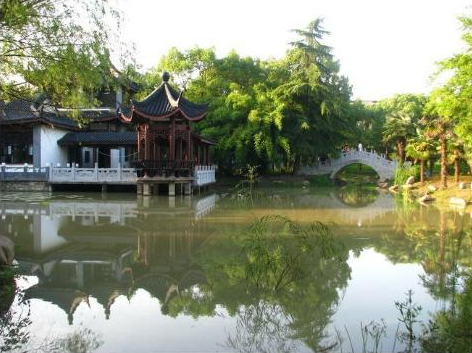 |
| Dong Yong Park |