Wedding lament, unique custom of the Tujia ethnic group
|
|||||||||


The Tujia ethnic group has a unique folk custom, in which the bride wails upon leaving her home on the wedding day. Women of Tujia ethnic group have the "weeping tradition" before marriage. They start to sing wailing songs for half a month, or even one month before the wedding day.
They may sing the wailing songs alone or with many people. The wailing songs signify the love and care received from parents from childhood, reluctance to leave brothers and sisters, abusing matchmakers and feudal ethical codes on marriage.
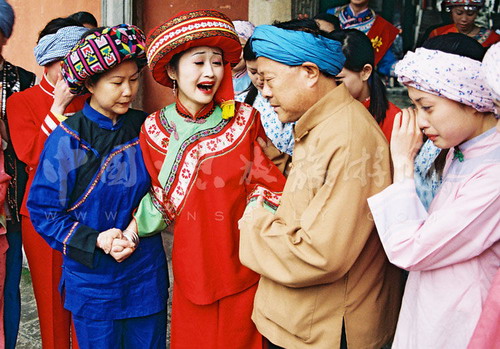 |
| Wedding lament |
Neighbors sing songs to persuade the girls to marry, mainly expressing congratulations to the newly wedded, praising the bridegroom, extending good wishes and luck. These songs are sung to traditional tunes and accents. The songs are sentimental and emotional, suffused with Tujia folk customs.
The wedding lament songs have novel styles and long or short lyrics to express explicit opinions. They are passed down over generations, or composed on the spot. The songs are rich in poetic rhyme, ingenious in dictions, and profound in implication. The songs also attack old systems, ridicule matchmakers, voice old passions, cherish the memory of landscapes, eulogize women, or look forward to the future.
The custom of the wedding lament has been carried from generation to generation. Through singing wailing songs, the brides-to-be vividly manifest their inmost intricate mentalities, exquisite emotions, and ethnic qualities. It is the magic of the Tujia ethnic culture.
Ten-sister singing is a unique version of the wedding lament for Tujia girls. On the night before the wedding day, the parents of the bride invite nine unmarried girls from the kindred and neighborhood to sit with the bride, singing through night. The bride begins to sing, followed by each of the girls in turn or in pairs. When a song is finished, they cheer with one voice "Happy". The crowd decides which of the girls wins, and which loses. The winner is awarded with candies, and the loser is punished to sing again. The songs are mainly to express congratulations, or description of daily lives. Sung gracefully to express emotions, the songs can be performed solo, antiphonal or in chorus.