Sister Festival of Miao ethnic group in Taijiang
|
|||||||||


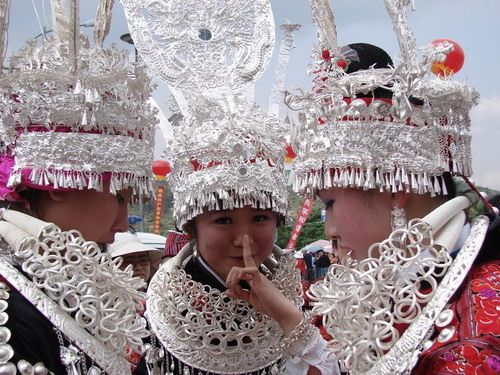
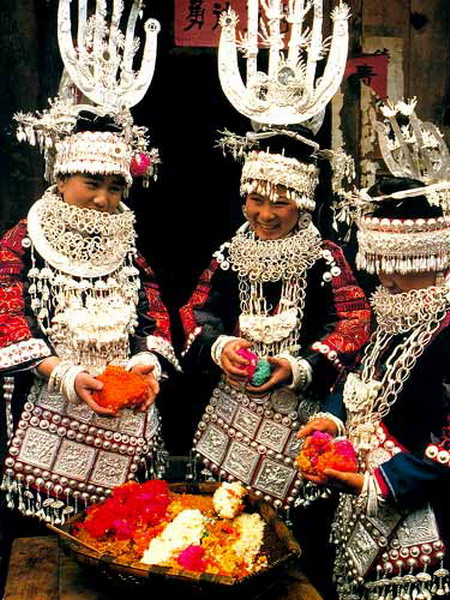
The Sister Festival, also known as the Sister Meal Festival, is from March 15 to 17 under the lunar calendar and is a traditional holiday of the Miao ethnic group in Laotun and Shidong of Taijiang county. The young put on festival costumes and gather to celebrate the joyous festival of rich national characteristics. There are, however, different branches of the Miao ethnic group that celebrate the festival at different times, usually from January to May. The most representative and influential is the Sister Festival in Shidong.
The festival centers on young Miao women. They invite lovers to wander and sing antiphonal songs, take the Sister Meal, dance to the accompaniment of reed-pipe wind instruments and timber drums, send tokens of love, and even get engaged. It is understood as a, "festival hidden in flower buds", and, "the oldest Valentine’s Day in the east.”
 |
| Sister Festival of Miao ethnic group in Taijiang |
Legends of Sister Festival
There are a lot of folk legends about the origins of the festival. Some believe it comes from unfolding the passionate love stories of young men and women living in the transitional period from the matriarchal to the patriarchal society. It also derives from the evolution of the matrimonial system of the Miao ethnic group.
1. Legend has it that there was a mountain village in Taijiang county and the men would go far away for hunting, leaving women, children and 70 pretty maidens in the village. Bringing up children and toiling in the fields, the women lived solitary lives. The maidens picked fruits, ploughed the field, spun yarns, wove fabrics and did embroidery. Despite this, the maidens still felt something was missing and were never fully content. The sisters decided and agreed to reclaim the land. They chose a piece of land with rich water sources, cultivated it whole-heartedly and eventually opened up vast fields. They also channeled water into the ponds and raised fish. The maidens sowed seeds of sticky rice in the fields in the spring and had a harvest in the autumn, and also brewed jars of wine from glutinous rice wines. Having enough to eat, drink and wear, they still felt something missing. The elders read their minds, telling them to save sticky rice and wine along with fresh fish and shrimps, to entertain young men from afar in the next spring.
During the time of Sister Meal, many young men had returned. The maidens entertained them politely and the young men showed their talents by singing, dancing, playing reed-pipe wind instruments, conducting bullfight and horse racing. The events bustled with noise and excitement. Just before parting, the maidens packed glutinous rice with embroidered handkerchiefs and sent them to their favorite young men. The young men accepted them cheerfully and showed up in the village again several days later, claiming to return the handkerchiefs. They brought with them many gifts to thank the maidens and after this they would fall in love.
 |
| Sister Festival of Miao ethnic group in Taijiang |
From then on, the custom of taking a Sister Meal and having a Sister Festival has been handed down from generation to generation. One day before the festival, the maidens of each Miao household will go to pick wild flowers and fruits and prepare the Sister Meal while young men stay in their company and talk to them.
2. There is a legend that the Miao ethnic group lived in the distant east a long time ago. Due to bigger populations, disasters and chaos caused by wars, they had to migrate westward. During this time the Miao girls got married on their journey to local residents. Since it would be exceedingly difficult for the girls to see her family, when spring came and flowers bloomed, they would catch fish and shrimp and invite married sisters back home for a meal and wishes. This led to the annual Sister Festival. As the proverb goes, it helps to pacify the endless missing in the year by sharing a meal with sisters.
3. The Sister Festival originated in the "meeting in the slope". According to the Song of Sister Festival, Ah Jiao and Jin Dan, childhood sweethearts, fell in love when they grew up. Despite their love, they could not get married because of the objection from their parents and clans. Each day, Ah Jiao went up the mountain with an excuse and hid glutinous rice in her bamboo basket for Jin Dan. Years later, moved by their love, the parents gave their nod of approval for the marriage. Young men and women of the Miao ethnic group admired Ah Jiao and Jin Dan for their persistence in love and followed their example to date on mountain slopes. The Miao ethnic group used to celebrate the festival everywhere they lived but now it has been lost in most areas except in Taijiang county.