Mausoleum of the Ming Emperor
( chinadaily.com.cn, zgmxl.com )
|
|||||||||


The mausoleum of Ming emperor has eight unique scenic spots:
1. Jade tower and twin graves
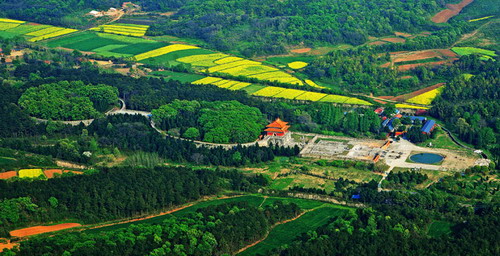 |
| The twin graves |
Emperor mausoleums of Ming dynasty had a unique structure with two graves in the front and back parts. This was closely associated with the identity of the master of the mausoleum. The front grave was built for Zhu Youyuan in the 15th year under the reign of Emperor Zhengde (1520).
When he ascended the throne, Zhu Houcong canonized his father as Emperor Xingxian. In the 17th year of Emperor Jiajing (1538), his mother died of an illness. He pondered whether to bury his mother in Beijing or bury her together with his father in the mausoleum. The emperor sent officials to investigate and opened up the underground palace, discovering it had water. In the second year, the emperor came to Zhongxiang and spurred the horse to climb the city wall. He had a stele erected behind the mausoleum, selected a new site, and buried his father and mother in a new mausoleum under a new map of the underground palace. The two graves were connected with a long platform, known as the jade tower. Among all mausoleums of the Ming Dynasty, only the Zhongxiang mausoleum has the unique structure of two graves joined by a jade tower. Each grave quarter of the mausoleum has a crescent wall, mute yard and colored glaze screen. It also has an independent drainage system.
2. Multiple stele pavilions
Another characteristic of the mausoleum is that it has multiple stele pavilions.
Among Ming emperor mausoleums, Huangling Mausoleum and Xiaoling Mausoleum were the only buildings with a stele pavilion at the front, with a pavilion for reconstructing Huangling Mausoleum and a stele tower representing the magical power and sacred virtue of the Xiaoling emperor. Another stele pavilion was added after Emperor Jiajing ascended the throne and conferred the locations for Huangling, Xiaoling and Zuling with the titles of Xiangshen Mountain, Shenlie Mountain, and Jiyun Mountain.
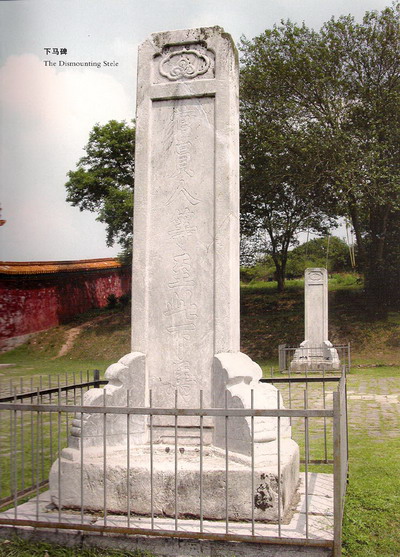 |
| The Dismounting Stele |
Changling mausoleum, located in Tianshou Mountain, Beijing, had the Shengong Shende stele tower made from Shende stele. In the 21st year of Emperor Jiajing (1542) rule, the emperor ordered another stele erected to the left of Changling gate. He also had steles and stele pavilions constructed in front of Xianling, Jingling, Yuling, Maoling, Tailing and Kangling mausoleums. These steles bear no inscriptions. Since then, mausoleums in Tianshou Mountain followed the same distinct pattern.
Xianling Mausoleum has more steles than other mausoleums. In addition to the Chunde mountain stele, others that have been found or recorded are the Shanqu stele, Ruigong Shende stele, Jiruiwen stele, Chunde mountain memorial stele, posthumous title stele, imperial conferred elegiac address stele, imperial conferred record stele, and minglou stele. Apart from the stele in the main gate hall, all other steles have pavilions or towers.
3. Twin dragon colored glaze screen wall
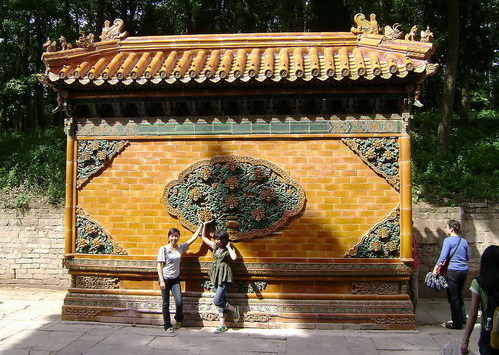
The exquisite colored glaze screen walls to the sides of the main gate are unique compared with other mausoleums of Ming dynasty emperors. As shown in the existing screen walls, they are made of colored glaze imitation wood pattern. The upper part is tile eave, under which there is colored, glazed imitation wood. The lower part is the Xumi altar. The front part of the hand-made flower heart is made from a jade flower pattern and the back part is the twin-dragon pattern.
 |
|
It is an exquisite colored glaze screen wall to the sides of the main gate. (photo from nipic.com) |
4. Outer walls and inner walls
Xianling, an independent mausoleum, has high surrounding walls, referred to as outer walls and inner walls. The architecture of Xianling mausoleum follows the pattern of seven Tianshou Mountain mausoleums. Only Linggong mausoleum has walls whereas other mausoleums do not have separate outer walls. There are also tightly guarded walls around the Tianshou Mountain mausoleum area. Following the construction of the Xianling mausoleum, Shizong emperor built his own Yongling mausoleum with outer walls that mapped beyond the walls of the mausoleum palace. This was imitated in the construction of the Dingling mausoleum in later days, leading to the development of a unique emperor mausoleum system. In this sense, Xianling mausoleum set the pattern for Yongling and Dingling mausoleums with outer walls.