|
A bear skeleton unearthed in central China's Henan province may reveal that Chinese people tamed bears at least 2,800 years ago, said archaeologists.
The skeleton was discovered at a cultural relic site in Taohe, a town in Nanyang, by archaeologists from the Henan Provincial Institute of Cultural Relics and Archaeology. The team was called in to perform a rescue excavation when relics were discovered at the construction site of China's south-to-north water diversion project.
Archaeologists estimate that the relic where the bear was buried was a sacrificial pit from the late period of the Western Zhou Dynasty (11th century to 771 BC).
"We don't know yet when the Chinese began to tame bears, but from the discovery of the skeleton we can at least infer that they had the practice during the late Western Zhou Dynasty," said Ma Xiaolin, an archaeologist with the institute.
After digging up and analyzing the bones, scientists speculated that the bear was tamed by ancient Chinese to be an offering to ancestors.
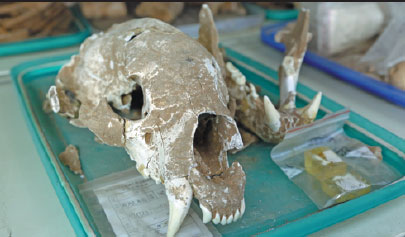
Judging from the shape of the bear's teeth and skull, it was a black bear, said Hou Yanfeng, another archaeologist with the institute. It was male, based on the large sagittal crest on its skull, he added.
From examining its lower teeth, scientists believe that it died in the early spring when it was 5 years old.
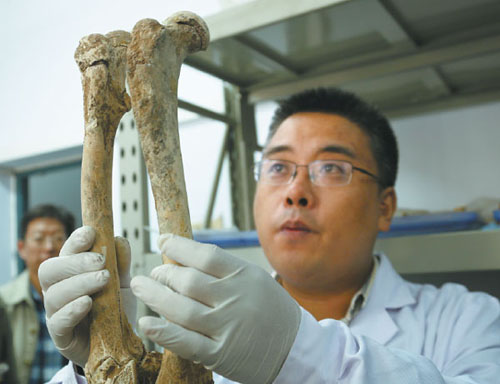
The team also found that the bear's left leg was 29 mm shorter than the right one. "To further investigate the cause of the limp, we had the left leg bone X-rayed and found that the leg had probably suffered from a fracture when the bear was a cub."
But the bear's survival and normal development of other bones suggest that the injury did not cause many adverse effects, such as starvation or danger of becoming prey for other animals.
However, it was probably captured and raised by humans as a result of the injury when it was a cub and less ferocious, and ended up as a sacrifice buried in the pit, archaeologists said.
According to Hou, the sacrificial pit is located at the birthplace of Chu, an ancient state in today's neighboring provinces of Hubei and Hunan, as well as part of Henan.
"Chu people bore the ancestral name of Xiong, or Bear, so it is very likely that bears were tamed and raised for sacrificial use at that time."
|
|
|
Hou Yanfeng, an archaeologist from Henan Provincial Institute of Cultural Relics and Archaeology, shows the bones of the bear's two legs, with one being shorter. [Photos By Jiang Yanwen / Xinhua]
|
|
|
|
Based on remains of its teeth and skull, archaeologists believe the skeleton is that of a black bear.
|
|