|
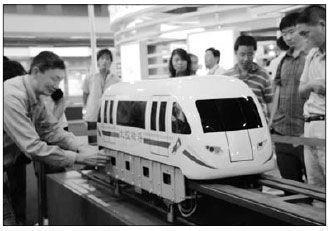
Model of the Beijing maglev train Geng Haiyang / China Daily |
Using proprietary technologies developed in China, Beijing's first magnetic levitation (maglev) rail line, the S1, is now under construction and scheduled for its first test run in 2013.
When complete, it will link Shimenying station in Mentougou district on the west of the city with Pinguoyuan station in Shijingshan district in the east.
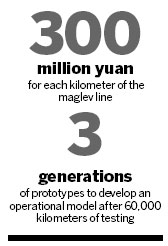
Though it costs around 300 million yuan ($45.7 million) for each kilometer, the line is far less expensive than an equal length of subway, said Li Jie, head of the maglev research center at the National University of Defense Technology, one of the developers.
"It will play a positive role in relieving the city's traffic congestion and at the same time promote energy saving and emission reduction," Li noted.
Unlike some ultra-fast maglev lines, the S1 is designed for low and mid-range speeds.
The project shows China is now capable of industrializing maglev technology that meets advanced world standards, experts say.
The approach uses powerful electromagnets for lift and propulsion, reducing drag because there is no friction from wheels.
The environmentally friendly maglev is quieter and smoother than wheeled mass transit vehicles and has a smaller turning radius and higher climbing ability. It also has the potential to be much faster.
Experts say the maglev is regarded as a symbol of a nation's scientific and industrial levels because it combines complicated technologies such as automated controls, sensors, power electronics and straight-line propulsion.
China began to develop its core maglev technologies in the 1980s.
Led by Chang Wensen, a professor at National University of Defense Technology, the research team mastered direction controls, steering bogies, system integration and other crucial components in the design.
In 1999, the university cooperated with Beijing Enterprises Group Co Ltd to undertake a state-level program to develop low- and mid-speed maglev applications, resulting in three generations of train prototypes and two test lines, all built with homegrown technologies.
The test line for the third generation prototype in Tangshan of Hebei province is 1.5 kilometers long and has turn with a radius of 50 meters.
The latest prototype is 14 meters long with top speed of 105 kilometers an hour and a carrying capacity of 15 tons. It has run for 60,000 kilometers since 2009, which meets the requirements for operating lines.
The train does not create high levels of electromagnetic pollution because the intensity of its magnetic field is equivalent to or even lower than a hair dryer, according to Li.
Shanghai has a maglev that began operation between Pudong International Airport and the central area in 2004. It has a top operational speed of 431 kilometers an hour, making it the world's fastest train in regular commercial service.
China Daily
(China Daily 03/09/2011 page17)
|