As companies in China's railway industry receive more orders from Southeast Asian countries, a tangible ripple effect can be seen in vocational schools.
The need for a significant number of skilled technicians in construction, operations and maintenance typically follows the signing of contracts for new railway projects, and Chinese training institutions are a good place for countries such as Laos and Thailand to train personnel.
Although there are no specific data, examples abound, such as in Guizhou and Hubei provinces, where vocational schools say they are receiving increasing numbers of students from Association of Southeast Asian Nations members and are launching training programs in ASEAN economies.
Guiyang Vocational and Technical College in Guizhou province has 36 students from a province in Laos enrolled in courses related to the railway industry, according to the school's Vice-President Liu Luming. The students spend a year studying Mandarin in their native country and then spend three years in Guiyang.
Laos and China have agreed to build a railway between Vientiane, the Lao capital, and Kunming in southwestern Yunnan province. Once complete, overland travel between the two cities will be cut to just two hours.
Luangluexay Bounchanh, deputy director-general of communications for Luang Namtha province, said Laos has only one railway connection, which is with Thailand, so there is a shortage of local professionals capable of railway construction and operation. One solution is to obtain help from Chinese vocational schools specializing in the railway industry. He said his department has contacted some of the schools and plans to send Lao students there.
Similar demand has come from Thailand, which also has sealed railway deals with China. Aganit Klungsang, deputy secretary-general of the Thai Vocational Education Commission, said his country would soon need a large number of specialized workers.
Wuhan Railway Vocational College of Technology in Hubei province signed a memorandum of cooperation in August with Thailand's Banphai Industrial and Community Education College to help train railway professionals.
The Banphai school will send at least 150 students a year to Wuhan for courses in railway operation and management, power supply technology and inspection and maintenance of high-speed trains. The first group has already arrived.
"This is just the start," said Cheng Shixing, president of the railway college. "There will be cooperation with more schools in Thailand."
And the vocational training cooperation is not only limited to the railway sector. As more investment from China goes to ASEAN economies as part of the Belt and Road Initiative - proposed by President Xi Jinping in 2013 as a way to revive ancient trade links between Asia and Europe - countries have found more opportunities to work together.
Thit Linn Ohn, Myanmar's ambassador to China, said at a recent vocational training forum that professionals who know how to repair automobiles, computers and watches were very much in demand in his country, where most businesses are small and medium-sized enterprises.
China sets a good example because its people are good at applying what they learn in vocational training directly to work, he said. "I fully support increasing the number of Myanmar students receiving vocational and technical training in China."
The situation in Cambodia is similar to that in Myanmar. Pit Chamnan, the secretary of state for education, youth and sport, said an increasing number of Chinese companies are investing in the country and that it needs skilled labor.
The central government's policy has been to stress vocational and technical training to meet the upcoming demand for skilled workers, especially those needed by Chinese investors, he said.
Attending vocational schools in China has multiple benefits for students from Southeast Asia.

A staff member with the Lao Ministry of Education who asked to be identified by his Chinese name, Chen Fuqiang, said 99 percent of the Lao students who graduated from Chinese vocational schools had landed a job, and many were receiving a salary twice that of their peers.
"Studying at vocational schools in China enables students to learn the language and understand more about Chinese culture, which gives them a great advantage in the job market, as 90 percent of foreign investment comes from China," he said in fluent Mandarin.
Souksakhone, a Lao student at Tongren Polytechnic College, a vocational school in Guizhou, said the China experience definitely gives students an edge: "There are great numbers of Chinese enterprises in Laos. Lao students who have studied in China and can speak fluent Chinese will be much favored."
She spent one year learning Chinese in Laos and said she will spend three more in vocational school before returning home to search for a job.
Souksakhone's choice is not limited to Chinese enterprises.
"With a certificate from a Chinese vocational school, I have a competitive chance of landing many other great opportunities, such as taking the exam to be a civil servant," she said.
Zeng Jun and Dong Xianwu contributed to this story.
Contact the writers through zhaoxinying@chinadaily.com.cn
|
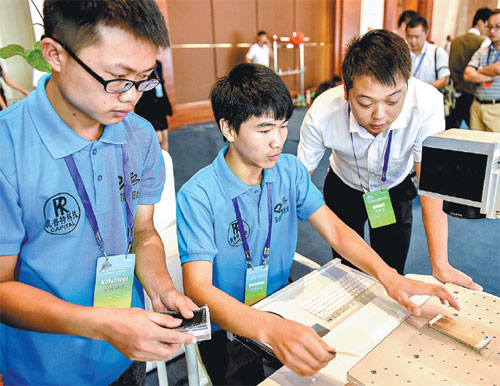
Students from a vocational school operate numerical control equipment at an exhibition that features educational exchanges between China and ASEAN member countries in Guiyang, Guizhou province, in August.? Liu Xu / Xinhua |
(China Daily 11/27/2015 page7)