People know climate change has been unsettling our planet's geological, biological and ecological systems, but how does it affect the living animals and plants on our planet, especially those rare species that live in protected areas?
Recently, the Nature Conservancy, an international green group, released a report in Beijing to address the question.
The organization launched a study in 2009 to analyze the impact of climate change in China's 32 land biodiversity conservation priority areas.
"We hope the study will provide a feasible approach for policy makers to respond to climate change, and better preserve biodiversity in protected areas," says Ma Jian, who directed the research project in China.
According to the study, within 50 years, the yearly average temperatures of the 32 assessed areas will
increase by about 3 C, and in 100 years, the jump will be as much as 5 C.
Ma says China now has 20 biomes, or large geographical areas of distinctive plant and animal groups that are adapted to a particular environment, and by the end of the century there will be 24.
During that time, the sizes and locations of those biomes will shift, some to higher altitude areas and some to lower altitudes. "The vegetation is changing in conservation priority areas," says Chen Ai, a biologist with TNC. "The more dramatic the vegetation change is, the more significant the alteration of all living species in those areas will be.
|
 |
|
|
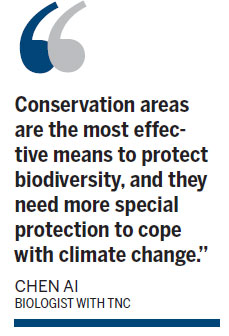
"Conservation areas are the most effective means to protect biodiversity, and they need more special protection to cope with climate change."
The TNC report points out that the Hengduan Mountain Region, stretching across the border areas of Tibet, Yunnan, Guizhou and Sichuan, are most sensitive to climate change and consequent possibilities of ecological changes. The areas are very complicated geographically, and have a wide range of rare species, such as giant pandas, Chen notes.
Based on prediction models, TNC estimates that forests in that area will undergo complicated distribution changes in 100 years, and the giant panda habitat areas in the region will shrink 56 percent.
Pandas will move to the north, and to higher altitudes, so policy makers will need to define new protection areas for them, according to Jin Tong, a scientist with the organization. Human interference with pandas' migrating path poses another threat, she adds.
Cai Lei, deputy director with the Ministry of Environmental Protection's biodiversity office, says the government appreciates what TNC has done. "We hope to cooperate with them to better protect our environment."