China's Five-hundred-meter Aperture Spherical Telescope, or FAST, the world's largest radio telescope, celebrated its first anniversary on Monday. But its founding father was not there to enjoy the moment: Nan Rendong, chief scientist of the FAST project, died from lung cancer at the age of 72, just 10 days before the celebration.
He underwent surgery after being diagnosed with the disease two years ago. When he was discharged from hospital, Nan was moved to a house on the outskirts of Beijing where he could grow flowers and walk his dog.
However, the old man could not bear such an idle life, describing it as "like being in jail". Nan continued to work despite illness, invoking the spirit of his own personal motto: "Refuse to be average."
The astronomer was known to often gaze at the starlit nighttime sky, pondering life's big questions. Who are we? Where did we come from? Are we alone in the universe?
This curiosity, as well as a sense of patriotism, prompted Nan to bid farewell to the good salary and world-class research environment he enjoyed as a visiting professor at the National Astronomical Observatory of Japan.
Nan had been in charge of FAST since 1994, leading the research team to work around the clock, pouring all his energy into the project, which some considered an impossible mission. He aimed to build the largest supersensitive "ear" on Earth to listen for distant signals in the universe and decode cosmic messages.
The main structure for the project - a 4,450-panel reflector as large as 30 soccer fields - was installed last year. It is capable of amplifying signals and searching for sun-like stars using technology five times more powerful than what was previously available. It can receive electromagnetic signals from 10 billion light years away, and perhaps bring the search for extraterrestrial life closer to what would be an astonishing conclusion.
Arduous task
Site selection was the most important challenge - and the biggest - at the initial stage of the project. Nan began site surveys in 1994, considering geomorphological features, climate, the engineering environment and radio interference.
Trudging up and down rugged mountains in Southwest China for more than 10 years, Nan finally found the ideal site, a karst valley deep in mountainous Guizhou province.
With little mature technology for reference, Nan encountered numerous technical difficulties. The team overcame more than 100 failures to solve a cable-net problem, for example, with Nan always at the forefront of trials during the construction process.
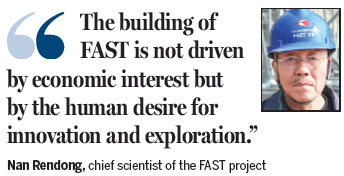
"The building of FAST is not driven by economic interest but by the human desire for innovation and exploration," Nan said. "You will always make unexpected gains during scientific adventures."
The radio telescope is expected to be the global leader for the next 10 to 20 years, according to Zheng Xiaonian, deputy head of the Chinese Academy of Sciences' National Astronomical Observatories.
The man behind this unprecedented project, though mourned by families, students and colleagues, wished for his funeral to be simple, with no event held.
"Attracted by its mystery and glory, we can go beyond mediocrity and step into the vast beautiful universe," Nan wrote.
Xinhua