 |
|
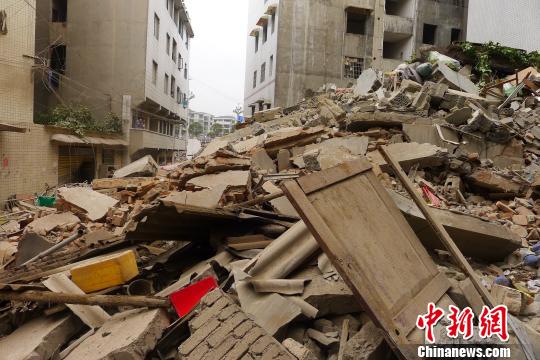
A seven-storey building in Zunyi city, Southwest China's Guizhou province, collapse at midnight, June 10, 2015. [Photo/chinanews.com] |
On June 14, an old building collapsed in Zunyi, Southwest China's Guizhou province, leaving four residents dead and three injured. It was the third building collapse in Guizhou in one month. And only after these tragic incidents did residents realize that lack of maintenance had become a common problem for buildings, especially the relatively old ones.
Ironically, property owners, or at least people who have bought houses, have been paying a certain amount as "public maintenance fund" since 1998. According to incomplete data from China Property Management Association, the fund now totals more than 500 billion yuan ($80.5 billion). Yet only a very small percentage of the amount has been used for maintenance of buildings.
In Wuhua district of Kunming in Southwest China's Yunnan province, for example, less than 2 percent of the total 430 million yuan has been spent on maintenance from 1998 to 2014 while most of the money has been "sleeping" in public accounts. The situation is similar across the country.
The situation can be attributed to strict official procedures for using the maintenance fund. According to a regulation on maintenance fund, jointly issued by the Ministry of Finance and the erstwhile Ministry of Construction in 2007, a community's maintenance fund should be deposited in a public account held by the property owners' committee. In case an apartment or a building needs to be repaired, the committee should first post a public notice, and, after getting the approval of two-thirds of the owners whose property account for more than two-thirds of the community, apply to higher authorities for the money. And only after the higher authorities clear the application can the committee withdraw money to cover 80 percent of the repair cost.
The regulation was designed to prevent misuse of the community maintenance fund. But the complicated procedure has made it difficult for owners to withdraw money when needed.
The situation is worse for old communities which have not formed property owners' committees. In such communities, homeowners who need to carry out repairs must approach enough residents and collect their signatures, which is almost mission impossible because a community could comprise dozens of buildings and thousands of families. And even after a homeowner manages to complete this step, he/she has Sisyphean task of paperwork.
Therefore, the authorities should urgently simplify the procedure because the Zunyi incident may appear to be an isolated case but the fact is, a large number of buildings built in the 1980s and early 1990s need urgent repairs. If revising the regulation is a very demanding task, at least provincial governments and legislatures can take provisional measures to make it easy for homeowners to use the maintenance fund.
Perhaps, provincial and regional governments can learn from the example of Shanghai, which has granted owners' committees the final say in the use of the fund - when property management companies realize a building needs repairs, they apply to and get the money from the committee to do so after obtaining the approval of two-thirds of the homeowners. As a result, Shanghai communities have used 3.8 billion yuan of the maintenance fund, or 8.6 percent of the total.
Of course, supervision must be strengthened to ensure the fund is not misused after the procedure is simplified. Maybe an online information platform that is fully transparent and open to all homeowners should be set up, with provisions of allowing property owners to call the authorities at even a hint of any misuse following which accounts could be frozen until investigations are completed. In other words, only by delegating power to owners' committees and properly supervising the use of power can the maintenance fund be used for the purpose it was set up.
The author is a writer with China Daily. zhangzhouxiang@chinadaily.com.cn.