|
A man walks into a fast food restaurant in China. What is he more likely to choose - a local brand, like Chongqing's Country Style Cooking, or an international chain, like McDonald's?
Chances are he's craving something local, perhaps a spicy beef and fish combo with rice, according to Country Style Cooking (CSC) CFO Adam Zhao.
"If you're given 10 chances to eat local fast food, the typical Chinese man would probably only walk into a McDonald's or other international chain twice, and would choose a chain with more local food the other eight times," Zhao told China Daily.
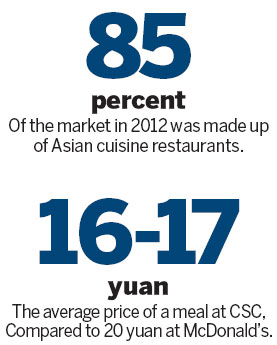
In 2012, Asian cuisine restaurants made up 85 percent of the market in China, according to Euromonitor's China Statistical Yearbook. Growth in China's quick service restaurants (QSR) has grown steadily since 2007 and nearly doubled in earnings from 357 billion yuan (about $58.3 billion) in 2007 to 648 billion yuan in 2012.
"International brands aren't selling food, they're selling a fantasy of the USA," Zhao said. "I think that's the key element of their success. But, Chinese people are picky on local food, so localization is one of the key features to being successful."
CSC is the biggest QSR chain in China's southwest Chongqing municipality, with a store count that surpasses both McDonald's and KFC in the area.
It is also the only Asia-based restaurant listed on the New York Stock Exchange. Zhao is stateside this week to participate in the Wells Fargo Securities Retail and Restaurant Summit in Boston.
Ultimately, the company's mission is to become the No 1 QSR brand in China. Zhao said the CSC group may look toward global expansion five to 10 years down the line, but he said the company remains focused on slow and steady domestic growth.
"We call ourselves the Zara of QSR," Zhao said, comparing the restaurant to the global fashion chain. "We have a very strong research and development team to come up with new food and shuffle the menu on a regular basis. You won't get tired of the menu ever."
Zhao said menus change almost every week and offer about 22 choices with free rice or soup add-ons. The menu includes 80 percent standard best-seller dishes and 20 percent rotated seasonal or new local dishes tailored to each city.
A typical staff of 20, including five chefs, can churn out a meal in 60 seconds at any one of its 250 Sichuan flavored restaurants located in Chongqing, Sichuan, Yunnan, Guizhou, Hunan and Shaanxi. The menu uses standardized recipes for combo meals that are prepared fresh onsite and paired with pre-made sauces.
Zhao said one of the restaurant's more popular items is ginger roasted duck, which sells more than 10 million pieces and contributes about 100 million yuan in revenue annually.
Wherever CSC is located next to a McDonald's or KFC, it apparently becomes obvious where the preference lies.
"You'll see a long queue in front of our store," Zhao said. "You will see that we have much higher traffic than [the international] guys."
Zhao said CSC runs a very high turnover business where tables turn an average 15-16 times a day in restaurants that typically provide 120-150 seats.
Monthly customer traffic expectations are about 38,000 people per store, according to a recent company report. Compared to McDonald's where Zhao said average spending on a meal is about 20 yuan, he said the average at CSC is about 16-17 yuan. CSC's second-quarter total revenue this year was $53.1 million, amounting to a year-on-year increase of 16.5 percent, according to the report.
"I think our competitive chances are favorable because we understand the local people's preferences," Zhao said. "I would admit the USA fantasy is attractive to some of the younger crowds, but ultimately your stomach does not lie."
Zhao said CSC recently developed a duel-brand strategy by introducing the Mr. Rice buffet style restaurant to help promote different brands in different regions. Since January 2012, Mr Rice has already established 40 restaurants in China's southwest region.
"I think the duel-branding strategy will help us accelerate our expansion into new provinces," Zhao said. "Our plan is to have 1,000 stores total by 2020, and we may create more brands suited to other regions."
Citing statistics from China's national restaurant association, Zhao said QSR makes up less than 6 percent of total spending in China's restaurant industry.
"I think [QSR] is an inevitable result of economic growth and urbanization," Zhao said. "Whether it's international brands or local brands, I believe both sides have their opportunities to grow."
carolineberg@chinadailyusa.com
|