|
The upcoming completion of the China-Myanmar oil and gas pipelines will significantly reduce the cost of China's energy imports and overcome the country's dependence on the Strait of Malacca, experts said.
"China's energy security will be further guaranteed by the exploration of the new import route through Myanmar, and the energy importing channels will be further diversified," said Xu Liping, deputy director of China's Center for South Asian Studies.
He said oil and natural gas from the Middle East and Africa will be transported by way of the Indian Ocean and the pipelines to China's vast inland, without detouring through the Strait of Malacca in Southeast Asia, which is controlled by the United States.
After three years of construction, the 800-kilometer China-Myanmar natural gas pipeline is expected to undergo testruns soon, and the oil pipeline will be completed in two to three months, Xinhua reported.
Wang Yanglong, a control center technician based in Mandalay, Myanmar, said his team is improving supervisory control and data acquisition systems and waiting for the order to put the pipelines into operation.
The project between China National Petroleum Corporation and Myanma Oil and Gas Enterprise also included the construction of a headquarters in Mandalay.
Zhou Dadi, vice-chairman of the National Energy Advisory Committee, called the pipelines a "reasonable energy arrangement", saying that the project could reduce the cost of energy transportation.
"It will especially fulfill the energy demands of Southwest China," Zhou said.
The $2.5 billion project marks the fourth-biggest channel of China's energy imports after the Central Asian pipelines, China-Russia pipelines and the maritime lanes.
Experts estimate that the pipelines will satisfy a quarter of China's natural gas demand every year, and also bring about $1.5 billion foreign exchange earnings to Myanmar annually, and it is a win-win cooperation between the two countries.
Xu said that ties between China and Myanmar will be greatly strengthened due to this project, as the two neighbors rely on each other in many aspects.
Myanmar President U Thein Sein hailed the China-Myanmar oil and gas pipeline project as "an important and mutually beneficial cooperation" in May, during a meeting with Liao Yongyuan, general manager of the CNPC.
Myanmar is opening up in all directions, but will still continue to maintain the China-Myanmar friendship and strive to enhance the neighborly, friendly and cooperative ties between the two countries, he was quoted by Xinhua as saying.
Myanmar has long been troubled by domestic conflicts, and doubts over the safety of the pipelines arose years ago when an agreement for the project was signed.
Xu said the pipelines are relatively safe because they mainly passes through areas controlled by Myanmar's central government.
"But pursuing peaceful and stable operations of the pipelines will still be the next challenge," Xu said. "The situation makes it rather important to promote peace in the country."
Zhou said the two governments need to secure the proper operation of the pipelines.
As an energy channel benefiting both sides, the project can provide "joint economic profits", which will be a solid foundation for further development of bilateral relations, Zhou added.
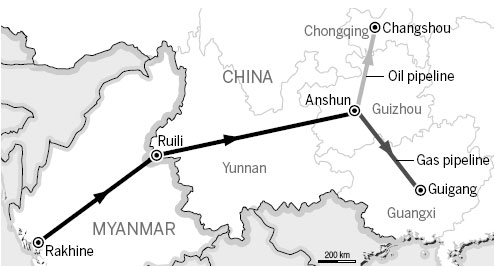
The China-Myanmar oil and natural gas pipelines, running parallel inside Myanmar, start near Kyaukphyu of Rakhine State, run through Mandalay, Lashio, and Muse before entering China at the border city of Ruili in Yunnan province.
The two pipelines separate at Anshun, Guizhou province, with the oil pipeline going to Changshou, Chongqing, while the gas pipeline extends to Guigang, Guangxi Zhuang autonomous region.
The designed annual capacity is 22 million tons for the oil pipelines and 12 billion cubic meters for the gas pipelines.
Zhang Fan and Xinhua contributed to this story.
puzhendong@chinadaily.com.cn
|