|
|

The Adunqiaolu Relic Site and Tombs in Wenquan county of the Xinjiang Uygur autonomous region, which experts say date back to 1900 to 1700 BC and belong to the Bronze Age. Photos Provided to China Daily
|
|
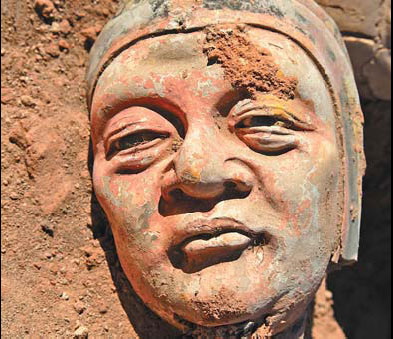
A clay sculpture unearthed at Xishanpo Buddhist Temple Ruins of the Liao Dynasty (916-1125) in the Inner Mongolia autonomous region.
|
|

A porcelain bowl unearthed from the Hailongtun Tusi castle ruins in Zunyi, Guizhou province. The castle was built in 1257 and ruined in 1600, experts say.
|
Chinese cultural heritage authorities announced the 10 most important archaeological discoveries in 2012 on Tuesday, with the earliest dating back to the Paleolithic era.
The selection panel, whose experts included representatives from the Institute of Archaeology under the Chinese Academy of Social Sciences, Peking University, Chinese Academy of Cultural Heritage and the Palace Museum, picked the final names from 25 candidates from around China.
At the news conference, Yan Wenming, an archaeologist from Peking University, highlighted the Shimao Ruins in Shaanxi province, which is rich in relics.
Archaeologists discovered ruins of a three-layered knoll town, which consists of an elevated core, and inner and outer city walls. The 2.5-meter-wide, 5,700-meter-long inner wall, built mostly on hill ridges, is relatively well preserved.
The city covers an area of more than 4 million square meters. Yan said the relic site is the largest town site known in China from the Longshan Period (2350-1950 BC) to Xia Dynasty (c.21st century-16th century BC).
Jade pieces, pottery and painted patterns have been found at the site, with some colored patterns remaining on the city wall.
Two pits, each with 24 human skulls, were found at the site, too.
"It can be related to religion, such as sacrifices when the city was built. And it indicates that the social strata might have appeared then," Yan added.
"It has provided whole new material for the research on the diversity of origin and development process of Chinese civilization and helped people better understand the early social structure."
The selection, held annually since 1990, is organized by the Archaeological Society of China and China Culture Relics Newspaper and supervised by the State Administration of Cultural Heritage.
Compared with previous years, when many projects were carried out for large-scale infrastructure projects, more active excavations for academic purposes are among this year's candidates.
"Excavations in coordination with infrastructure projects can facilitate urban development and popularize archaeological knowledge. They will remain our focus," said Tong Mingkang, deputy director of the State Administration of Cultural Heritage.
But he added that in the future, more attention will be paid to active excavations, which often lead to new discoveries.
Tong said academic importance is the first criterion for the selection committee. Meanwhile, balance is considered too. For example, representative archaeological discoveries of different eras and regions are included in the shortlist.
"Another important principle is that the selection must fully reflect the concept of protection of cultural relics," Tong said.
Tong told the conference that more than 100 relic sites listed in recent years have been listed as nationally protected heritage, and most of them have received good protection from local governments.
Tong and experts at the conference said that 2012 was a peak year for archaeology, and many of the failed candidate projects, such as the Mazong Hill jade mine site in Gansu province, have important archaeological significance nevertheless.
liuxiangrui@chinadaily.com.cn
|