|
 |
|
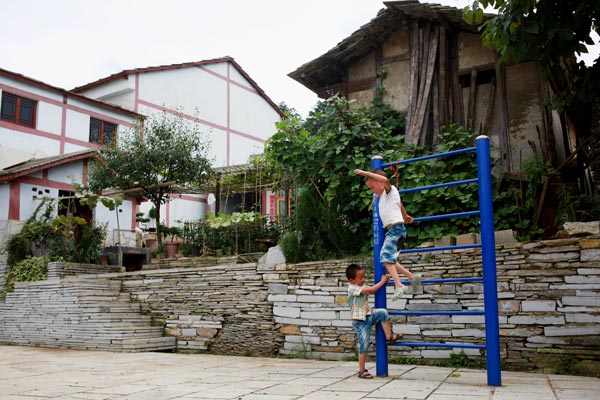
Children play at the exercise area of Baigong village in suburban Guiyang, Guizhou province. Photos by Wang Jing / China Daily
|
 |
|
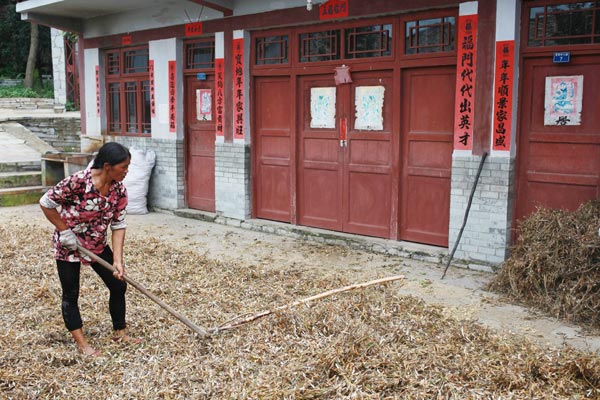
A woman villager collects soybeans at her family's courtyard.
|
Since it was chosen as a pilot eco-village project, Baigong has witnessed a dramatic change in its look. The lives of villagers have also improved. Liu Xiangrui tours the village and files this report from Guiyang.
Unlike its neighboring villages, Baigong looks more like an urban community at night with its 35 solar LED road lamps automatically switched on once it turns dark.
The only thing that reveals its state of being rural is its green fields, where residents have lived on farming for centuries.
"In the past, all we thought about was having enough land to cultivate and having enough food to feed ourselves," says village head Huang Peihai, 49. "But in the last few years, we worry about the ecological development in Baigong."
The village in suburban Guiyang, Guizhou's provincial capital, has witnessed a dramatic change in its look and the lives of the villagers have improved drastically in recent years.
In late 2008, Baigong was chosen as an experimental base for clean energy and low-carbon development, as Guiyang strived to build itself into an eco-city.
Step by step but very quickly, its houses, environment and infrastructures underwent major integrated improvement.
"Previously, the village was filled with filthy water, and the roads used to be full of litter. We felt embarrassed whenever there were visitors or relatives in town," villager Peng Guohong recalls.
"But now, we feel so good with the improved environment. We are also more aware about our actions to ensure we don't damage the environment."
Less than a year after being picked as a pilot project, Baigong's "green village" reputation attracted attention, and it was selected to be the first site of the "Thousand Villages Plan" during the first session of Eco-forum Global, an international ecological forum held in Guiyang annually now.
The plan was an ecological program initiated jointly by the environmental organization Climate Group, former British prime minister Tony Blair, and China's celebrated kung fu actor Jet Li's One Foundation.
The project aimed to solve the lighting problem and promote ecological awareness in rural China, Japan and Africa.
"Before the project in 2009, we had never seen solar lights," says Huang. "Our villagers were so happy to see our village lit up at night. Since then, many of us would come out of our houses to chat with other villagers under the bright lights."
The introduction of ecological development has prompted village authorities to learn from the experiences of some model villages. They also actively promote green lifestyle among the villagers including kicking away the old habits of littering and burning straw casually.
"It was hard to change the old practices," Huang says. "So, we took a practical approach, which is to ensure that the green development brings about economic benefits."
The village authorities decided to diversify the village's agricultural products, from traditional corn and rice to more profitable organic vegetables, which economized the limited land in the village and increased outputs.
The village even formed a vegetables' committee to purchase the farmers' produce and market it collectively.
Before the change, the village with a population of about 300 people was lagging behind economically. The per capita income stood at 3,200 yuan ($503) a year and many young villagers leave home in search for better opportunities in cities.
"Now the figure has jumped to 7,200 yuan," says Huang. "The villagers not only enjoy a better environment and nicer houses to live in, but also have deeper pockets now."
Almost every family has voluntarily built their own biomass pools for cooking and showering.
Villagers regularly attend classes on biological development and environmental protection. They also take up lessons on Putonghua (Mandarin).
Baigong's reputation as a low-carbon environment-friendly village has also drawn lots of tourists - which provided another source of income for the residents.
Peng Guohong's family started a farmer's restaurant to cater to the tourists. In 2010, he opened a "happy farm", to rent out his land to tourists who want to experience the pleasure of farming.
"We are really reaping the benefits of the green development, which has changed the villagers' lives drastically," Peng says.
Contact the writer at liuxiangrui@chinadaily.com.cn.
|