News
Where teachers are scarce, internet fills gap
Updated: 2016-11-04By Wang Ying in Shanghai ( China Daily Africa )
A broader school curriculum is reaching some of China's most remote communities, thanks to technology
Although he lives in a remote village in Gansu province, 10-year-old Xu Guohua dreams of learning to paint and going to study in Hong Kong one day.
Xu's artistic ambition has been inspired by a weekly internet learning experience that started a year ago when his school, Youfang Primary School, joined the NGO Project VolunOnline.
"I like Miss Fei's painting class the most, so Monday afternoon is the time of the week I most look forward to," the fourth-grader says.
|
Students in an online class offered by NGO Project VolunOnline in Pingliang, Gansu province. Provided to China Daily |
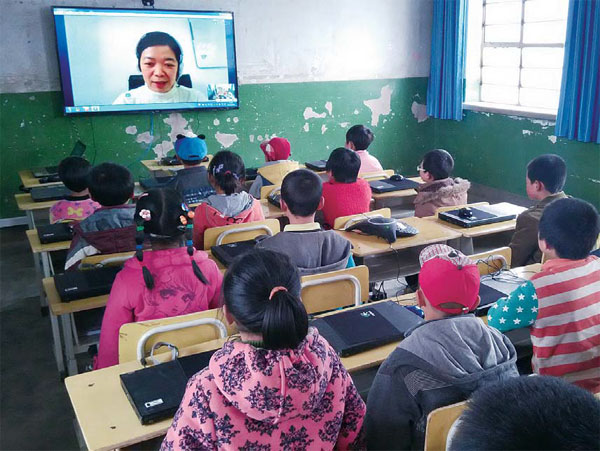
Fei Mengtian is a doctoral student at Hong Kong University, one of seven volunteers designated to teach students at Youfang Primary School via the internet on a weekly basis.
"Miss Fei tells us lots of interesting stories about the outside world. Last time, I drew a Ferris wheel from an amusement park," Xu says.
Like many of his classmates, Xu comes from a family of migrant workers and hasn't had much opportunity to explore the world.
"Schools like ours do not have enough teachers, let alone people who can teach specialist topics. The internet class teaches subjects such as English, computing, painting and psychological health as well as Chinese history, all of which are popular with the kids," says headmaster Yue Faqiu.
According to Yue, since November 2015 the school has received donations of new and used computer equipment that makes internet teaching possible.
Youfang Primary School is one of 19 schools which have introduced Project VolunOnline since July 2014, and its voluntary teachers come from nine nations and regions, including the United States, Germany, Turkey, Singapore, the Philippines, Malaysia, Australia and Hong Kong.
Gu Siyi, founder of Project VolunOnline, says: "Contrary to what I had imagined, some schools in remote areas are not short of instruction facilities, but they don't know how to use them to aid teaching. For example, I once saw a 178 centimeter touch-screen television covered with chalk dust in a school, as the headmaster didn't know how to switch it on."
Gu says he decided to help such schools with a special charity providing actual education, rather than donating materials as traditional charities do.
Ucome Public Service Center is another charity organization supporting education in China. In March 2014, after a year of research, the center launched its first internet teaching school. It now serves 66 schools and plans to expand that number to 122 next year.
"Our efforts are far from enough, because there are 90,000 schools in China that are short of educational resources, according to the Ministry of Education," says Yuan Li, director of Ucome Public Service Center.
"The biggest problem for schools in rural areas is the shortage of teachers, especially young teachers. Many schools cannot teach subjects such as English, physics, and music," says Jing Pan, executive director of Teach Future China, which is affiliated with the UNESCO International Research and Training Centre for Rural Education.
"I have been to a school where 16 teachers teach more than 500 students, and many students do not have a teacher during class time," says Jing.
Although there are 50 NGOs in China providing volunteer teaching to remote areas in central, western and northern regions, the period for which they teach, which averages half a year, is still far less than the ideal period of two years, according to Jing.
In reality, it is unlikely that a volunteer will give up everything to stay and teach for two years in a remote area, but it becomes possible if classes are taught online.
In the internet era, classes that were once taught with the aid of video and recordings are now being replaced with interactive teaching, which will greatly enhance the quality of education, says Ren Youqun, a professor from East China Normal University.
Ren says internet teaching in the future will be done on smartphones and tablet computers due to the popularity of these devices.
"This is especially true for smartphones, as they become a basic equipment, even for those living in remote areas."
wang_ying@chinadaily.com.cn
(China Daily Africa Weekly 11/04/2016 page15)
News