Biz updates
Initiative a product of Chinese wisdom
Updated: 2015-09-03By Wang Yiwei ( China Daily )
 |
|
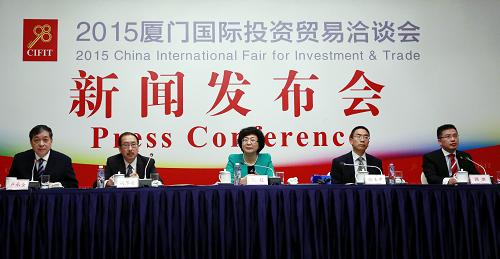
Organizers for the 2015 China International Fair for Investment & Trade held a press conference in Beijing on August 12, 2015. |
The Belt and Road Initiative, a grand transnational project comprising the Silk Road Economic Belt and 21st Century Maritime Silk Road, is the latest example of China's changing role in globalization - from a participator to a leader.
Characterized by rejuvenation, inclusiveness and innovation, the initiative is a product of Chinese wisdom, which aims to make China an important part of a more inclusive globalization process, in a bid to share the advantages of modernization with countries along the routes. Unlike Western colonialism and imperialism, the Belt and Road Initiative has been designed to strengthen the established multilateral cooperative partnerships between China and more than 60 other countries along the routes that run through Asia, Europe and Africa.
It is an all-round open initiative, which once realized, will benefit not only countries and regions along the routes but also those beyond, and facilitate a new mode of multinational integration. As such, the less-developed areas in Northwest China, such as Gansu province, will get greater support to enter the markets in the country's coastal region and even countries along the Silk Road Economic Belt. International organizations that show interest in taking part in the two projects are welcome to increase economic interactions among governments, enterprises and ordinary people along the routes.
On the one hand, the Belt and Road Initiative is expected to improve interconnectivity across the routes, with special focus on infrastructure facilities, ranging from transportation and communication to logistics. On the other, the initiative should help Chinese manufacturers enjoy greater say in global trade, and prompt them to venture into the global market with high-end products, instead of cheap knockoffs.
Besides, Beijing has kept an open mind, as opposed to parochial mentality, about the implementation of the massive initiative. Its unwavering adherence to the principle of non-interference in other countries' internal affairs is likely to guide it through the dangers of interest-oriented clashes. With its domestic interconnectivity network almost complete, China will make more efforts to help build an inclusive Europe-Asia-Africa community, in which all regional economies can enjoy the benefits of reciprocal exchange of political support, trade and investment. Needless to say, the initiative's success doesn't depend on one country's efforts or success alone.
For starters, governments should shelve their differences and seek more common ground, and hold dialogues and negotiations to eliminate the political barriers that prevent them from cooperating with each other. They also have to enhance facility-based interconnectivity, as part of infrastructure improvement such as transport and cross-border communication networks, and power plants.
In particular, priority should be accorded to the management and protection of key routes, so that a standardized mechanism of road transport can improve cross-country delivery services. Also, pivot harbors and airports in all countries concerned should be encouraged to work together to support inland transportation. And transnational pipelines, as well as electricity and communication networks based on undersea cables and satellites, should be made to play a bigger role in improving regional interconnectivity.
To make trade and investment exchanges with other economies along the routes more convenient, Beijing has to lift barriers unilaterally, and take measures to ensure the implementation of the deals agreed to protect multilateral trade and investors' legal interests. The signing of more high-level free trade agreements, like the one between China and Australia, could also help solve the interconnectivity problem.
As a major move for the success of the Belt and Road Initiative, flow of capital should incur lower costs and must be safer. A further boost could come from more participating countries expanding their currency settlement to general trade. More importantly, increased people-to-people exchanges in the fields of education and tourism can create and deepen a shared cultural identity between China and its partner countries.
The author is a professor of international relations at Renmin University of China.
News