 |
|
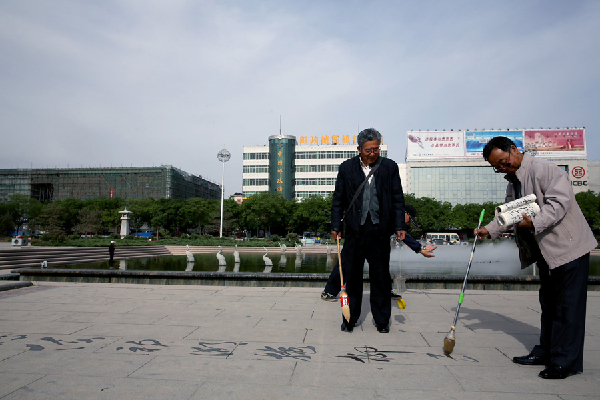
Two men practice Chinese calligraphy in front of the Giant Buddha Temple in Zhangye, Gansu province.[Photo by Jiang Dong / China Daily] |
China and other countries along the ancient trade route are working to rejuvenate economic ties shared for millennia. Zhong Nan reports.
As a land-entry port and border market connecting China and Kazakhstan, Horgos is known as a border station in the Xinjiang Uygur autonomous region's Ili Kazakh autonomous prefecture.
Its history can be traced back to China's Sui Dynasty (AD 581-618), when the port served as part of the Silk Road's trade routes.
Around 2,000 years ago, caravans of camels carrying goods followed specific routes across Eurasia, crossing mountains and deserts, and linking the continent's east and west through the trade of silk, jewelry, handicrafts, spices and seeds.
The Silk Road was a practical route for trade and cultural exchange, connecting China and European countries since around 100 BC, with Central Asia as the intermediate station. It became prosperous in China's Tang Dynasty, when the capital of ancient China, Chang'an (today's Xi'an), was opening up and hosted envoys from over 70 countries, including foreign government and religious delegations, merchants and overseas students.
During his visit to Kazakhstan in September 2013, President Xi Jinping proposed that China and Central Asia join hands to build a Silk Road Economic Belt. The idea has been echoed in Central Asian countries.
The combined population of the belt's countries is nearly 4 billion.
The belt connects the Asia-Pacific economic circle in the east and the European economic circle in the west. Countries along the belt have great potential to cooperate in many fields. These include infrastructure, transportation, tourism, finance, energy, telecommunications, agriculture and manufacturing.
Now the journey's eastern destination, the world's second-largest economy, is devoting itself to rejuvenating the Silk Road and bringing new economic impetus to countries along the ancient route.
Since 2010, major Chinese cities, including Chengdu, Chongqing, Xi'an, Zhengzhou, Wuhan and Yiwu, have launched weekly or monthly block-train services to European and Central Asian destinations. This is part of China's effort to turn its inland resources and labor-rich cities into international trade hubs.
A "Silk Road Economic Belt" agreement was signed by 24 cities from eight countries along the Silk Road last November to boost multilateral cooperation, development and prosperity.
Copyright 1995 - . All rights reserved. The content (including but not limited to text, photo, multimedia information, etc) published in this site belongs to China Daily Information Co (CDIC). Without written authorization from CDIC, such content shall not be republished or used in any form. Note: Browsers with 1024*768 or higher resolution are suggested for this site.
License for publishing multimedia online 0108263 Registration Number: 130349 

