Arts and traditions
Walking on Stilts (ICH)
Updated: 2013-10-30( chinaculture.org )
The first list of Intangible Cultural Heritages was approved by the nation in 2006.
(Beasts on Gaoqiao, Haicheng Gaoqiao, Western Liaoning Gaoqiao, Kushui Gaoqiao)
Year:2006
Sort:Folk Dance
Area:Shanxi, Liaoning and Gansu provinces
Serial No.:Ⅲ-9
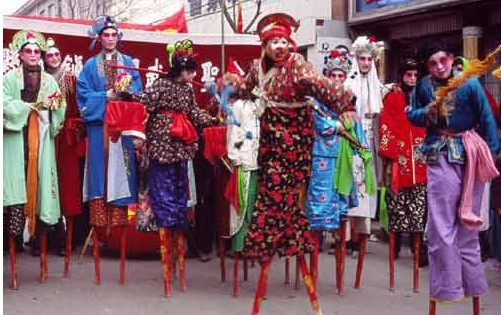
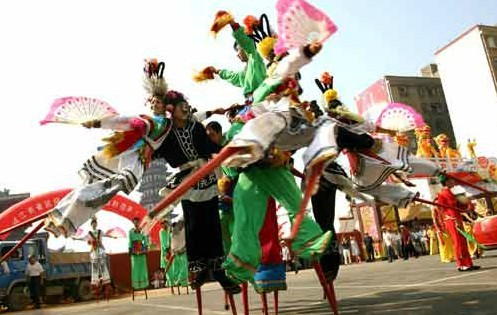
CaiGaoqiao, orwalking on stilts, is another popular traditional performance of the Spring Festival, especially in Northern China. Cai means walking on, and Gaoqiao means stilts. According to the archives, the ancient Chinese began using stilts to help them gather fruits from trees. This practical use of stilts gradually developed into a kind of folk dance.
Scholars believe Gaoqiao originates from the totem worship of primitive clans and the fishermen's lives along the coast. Historians have proven that the Danzhu clan in the times of the Yao and Shun emperors (3000 B.C.-2100 B.C.), who took the crane as their totem, walked on stilts during sacrificial ceremonies and imitated the dance of the crane. Archaeologists say some oracle-bone scriptures had images of people dancing on stilts.
Gaoqiao performance requires a high degree of skill and has various forms. Usually performers tie two long stilts to their feet, making them higher than others when standing on stilts.
Most stilts used are made from wood. There are "double stilts" and "single stilt" performances. The double stilts are usually tied to one's calf to fully demonstrate his skill; and the single stilt is held by the performer so that he can go up and down freely.
The performance can be also divided into Wenqiao (civil) and Wuqiao(martial). The former stresses appearance and amusement, while the latter emphasizes individual unique skill. Gaoqiao has now assumed strong local flavor and national color.
I Beasts on Gaoqiao
Declarer: Jishan county,Shanxi province
The 'Beasts on Gaoqiao' is a popular performance attemplefairs in Yangcheng Village, Jishan county, Shanxi province. It formed in the earlyQing Dynasty(1644-1911) and has a history of more than 300 years.
The 'Beasts on Gaoqiao' is made up of the beast head, beast body, and the performer. Usually two performers perform together, acting as if they are riding on the beast while standing on the stilts, with heavy load on the back, and dancing to the bright tune. The orchestra employs percussion instruments like gongs and drums. All the beast images still keep the original primitive appearance, their head made up of flax, jutepaper, strings, bamboo strips, iron wire and cloth. They are colorfully painted and seem powerful and refined.
The 'Beasts on Gaoqiao' performance is not only a popular entertainment for the masses, but also a way to pray for good weather and a bumper harvest in the next year.
II Haicheng Gaoqiao
Declarer: Haicheng city,Liaoning province
Haicheng Gaoqiao, a favored folk dance of the Haicheng people, took form in the Qing Dynasty. The performance, jubilant, bold, ardent, and humoristic, is a square activity for the mass entertainment, combining various art forms such as music, dance,acrobaticsand opera, etc.
III Western Liaoning Gaoqiao
Declarer: Jinzhou city, Liaoning province
The Western Liaoning Gaoqiao has a history of more than 200 years. It features high stilts, with the lowest 90 cm and the highest about 240 cm. Hence, the performers have to constantly wave their arms to keep balance on so high stilts. It is unique compared with other Gaoqiao performances all over China, and reveals the bold and generous character of the people in western Liaoning Province.
IV Kushui High Gaoqiao
Declarer: Yongdeng county, Gansu province
Kushui High Gaoqiao originated in the Yuan and Ming dynasties (1271-1644), with a history of about 700 years. It is a traditional repertoire of the Dragon-Head-Raising Festival in February 2nd of the lunar calendar. The stilts can be as high as 3 to 3.3 meters.
 |
|
CaiGaoqiao, orwalking on stilts, is another popular traditional performance of the Spring Festival, especially in Northern China. Cai means walking on, and Gaoqiao means stilts. |
 |
|
CaiGaoqiao, orwalking on stilts, is another popular traditional performance of the Spring Festival, especially in Northern China. Cai means walking on, and Gaoqiao means stilts. |
News