
Cultural elements key to Pingtan's tourism industry
( chinadaily.com.cn )
Updated: 2013-04-15
|
|||||||||


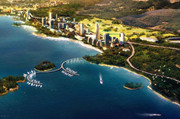
With booming cross-Straits tourism, Pingtan, the closest point to Taiwan on the Chinese mainland, should take full of its natural geographic advantages to embrace the industry, experts said at a forum in Fuzhou on April 13.
The 2013 Strait Tourism Culture Development High Profile Forum welcomed scholars and pundits from economic, tourism and cultural sectors. It cast a spotlight on a variety of tourism patterns that can be adapted in Pingtan, an island county in Southeast China's Fujian province.
Similar cultures, a close kinship and geographic proximity with Taiwan all help lay a foundation for Pingtan's tourism. In addition, a second shipping route between the two will open in May, according to Wang Lirong, a researcher with the Taiwan-based Chung Hua Institute for Economic Research.
She proposed that economic prosperity should go hand in hand with a healthy tourism market.
"There are still doubts about (the development prospects of) Pingtan because of lack of knowledge," she said. "Through tourism, we can help people get to know Pingtan better, which will help boost investment and trade. As a result of economic growth, tourism will flourish. It is a virtuous circle."
Cross-Straits travel has made great strides since Taiwan lifted its ban on mainland tourists in June 2008. A total of 2.9 million Taiwan people visited the Chinese mainland in 2012, making the mainland the most popular destination for tourists. As many as 7.31 million mainlanders have toured Taiwan in the same span, accounting for 35.37 percent of Taiwan's inbound travelers.
Many Taiwan people visiting the Chinese mainland are driven by a desire to find their roots. To cultivate cultural tourism and expose cultural origins to Taiwan people can be a focus for Pingtan's tourism, said Wang. Her opinion was echoed by many other experts.
"The Mazu culture, Hakka culture and Minnan culture shared by Fujian and Taiwan all originated from the Chinese mainland," said Yuan Shuqi, a professor with the Tourism Institute of Fujian Normal University. "A sharp increase in tourists will be seen if (Pingtan can) integrate them."
Culture is the soul of tourism, says Yang Hongxu, a famous financial commentator. "Pingtan should fully explore its natural gifts to build a cultural brand and highlight its unique cultural features, including preservation of local ancient buildings."
As for the preservation of traditions and cultures, Yuan thinks the Chinese mainland can learn from Taiwan, which is making great efforts to "deeply integrate culture and tourism".
Edited by Chen Zhilin and Michael Thai