|
A well-known historic and cultural city, Fuzhou was founded more than 2000 years ago. In the 5th year of Emperor Gaozu of the Han Dynasty (BC 202), Wu Zhu, descendant of Gou Jian, the king of Yue State, was declared the king of Min and Yue and began to construct Ye City, the earliest form of Fuzhou city.
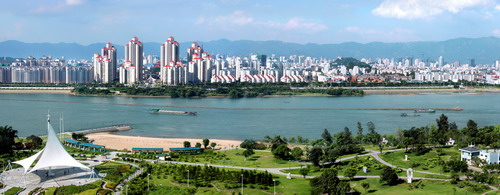
In the 13th year of the Kaiyuan period of the Tang Dynasty (AC 725), Fuzhou got its present name from a Fu (“fortune”) mountain to the northwest of it. In the Yuan Dynasty (AC 1206-1368), Fuzhou was set as the capital of Fujian province, which it has remained ever since. In 1946, it was formally named Fuzhou city. On Aug. 17th, it was liberated and set as the capital of Fujian province.
Fuzhou is called “the Zhoulu of the seaside” due to its rich culture and numerous talents (Zhoulu was the hometown of Confucius). In Tang Dynasty (AC618-907), Han Yu, the great poet once said: “Fuzhou nurtures many talents who not only excel in writing but also participate in politics.”
Therefore, it can be seen that the level of culture in Fuzhou can even compare with that of Chang An, China’s capital during the Tang Dynasty. A poem written during the Song Dynasty (AC960-1279) described the advanced education and culture of Fuzhou this way: “Nine out of ten pedestrians are scholars, while the sounds of reading can be heard along the street.”
The Chaojing Building at that time was the first public library in China, and Shigu College is regarded as one of China’s four great colleges. Fuzhou has been the cradle of China’s modern industry, technology and navy since the Ming Dynasty (1368-1644).
Distinguished by its external-oriented location and rich history, Fuzhou boasts its rich Tanshi Hill heritage, Chinese Ship Building, Three Alleys and Seven Lanes, Shoushan Stone, etc. Other historic sites, such as the Cliffside Inscription at Gu Mountain, Hualin Temple, the earliest wood construction, the Cliffside Inscription at Wu Mountain, the Inscription on the Tree at Xuefeng Temple, have gained international fame as well.
Seventeen national key historical sites are located in Fuzhou, including the Main Hall of Hualin Temple, the Tomb of Lin Zexu (the hero who fought against English opium exports in the late Qing Dynasty), the Majiang Sea Battery, the Martyr Tombs, the Maitreya Portrait on Fuqingrui Stone, the Chongmiaobaosheng Tower, the Office of Luo Yuanchen, Tanshi Mountain heritage, Fuzhou Ship Building Bureau, Cliffside Inscription at Gu Mountain, Yongtai Mountain, Changleshengshou Tower, Three Alleys and Seven Lanes,Zhuzi Mill, Confucius Shrine, Stone Carving at Luoyuanqiyun, Clay Sculpture at Changle Palace, Tablet at Linji Palace, Home of Yan Fu (enlightener, translator and educator of the late Qing Dynasty).
The ancestors of Fuzhou also left us with twelve priceless elements of Chinese cultural heritage, inscribed in the national list, including Min opera, Shifan music, book critic, Fuzhou singing, Stone Carving of Shou Mountain, bodiless lacquer, lantern festival customs, soft wood paintings, Buddha Jumping over the Wall (seafood and fowl cooked in earthen jar), of Juchun Garden, She minority’s medicine at Luoyuan county, play of Chen Jing Goddess, and the costumes of the She minority.
(1) Known as the three treasures of traditional arts, abreast with Beijing cloisonné, earthenware of Jingde town, Jiangxi province, bodiless lacquer, is distinguished by its bright color, solid and durable quality.
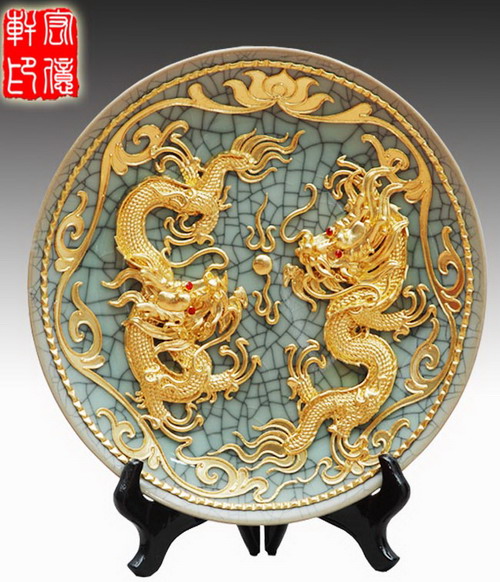 |
| Fuzhou Bodiless Lacquer |
(2) Drawn on bark with a sharp knife, the soft wood painting presents the vivid and subtle images of pavilions, trees and flowers, small bridges on running brooks, corridors, figures and animals. It achieves the effect of implanting a panorama in one picture.
(3) The Comb of Ox Horn brushes one’s hair with its elegant shape, classic material and dedicated craftsmanship.
(4) With refined embroidery and choice material, the paper umbrella is delightful on sunny or rainy days.
(5) With raw lacquers as its medium, the lacquer painting depicts vivid figures, landscapes, flowers and animals in the form of fresco and screen.
Fuzhou is also the origin place of Min cuisine, one of the eight major Chinese cuisines. Min cuisine is known for its delicate materials, fresh colors and good taste. Buddha Jumps over the Wall, Braised Sea Clam with Chicken Soup, Sliced Whelk with Weak Wine Sauce, Litchi Pork, Fish Ball, and Dried Meat Floss are the typical dishes in Fuzhou.
Translated from fuzhou.gov.cn
|