Unique islet's rich and diverse history gains international recognition, Li You reports.
The historical international settlement of Gulangyu Island, in the bay of Xiamen, Fujian province, has recently been recognized by UNESCO on its list of World Cultural Heritage sites.
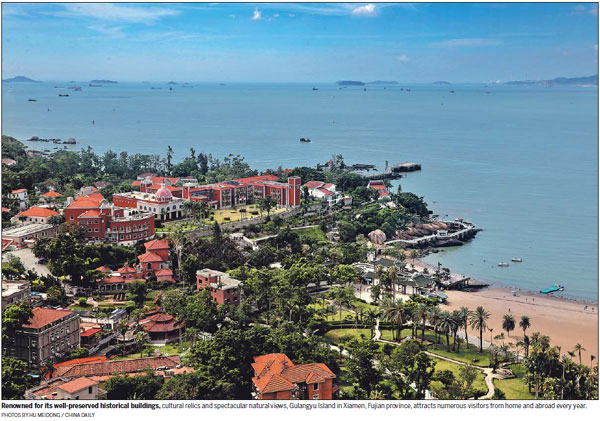
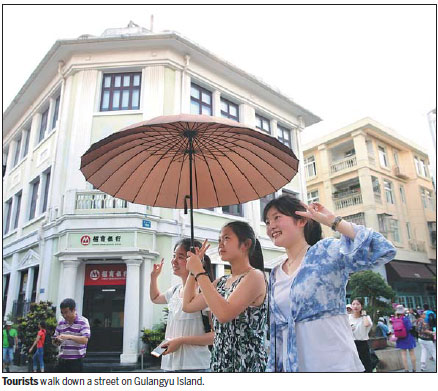
Known in the local dialect as Kulangsu, the 1.88-square-kilometer islet, with giant banyan trees shading the graceful roofs of European-style mansions, is the destination of 50,000 visitors every day.
Although regarded as a peaceful tourism spot by Chinese people today, it has been a turbulent place in modern history.
The boutique shops, kitschy bars, restaurants and hotels sprung up in recent years, but the mansions, luxuriant foliage and winding roads were not built to amuse tourists at first.
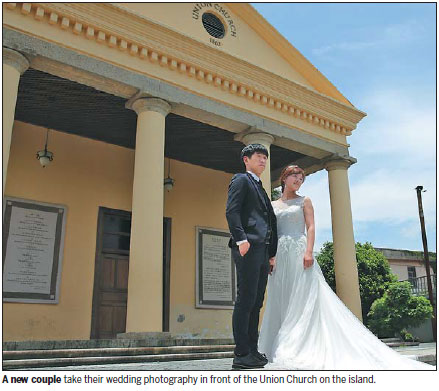
The site of the former municipal council, court, police station, foreign consulates, schools, private gardens, Protestant churches and Catholic cathedrals, mansions, and a spectacular Buddhist temple together constitute the historical monument built up over hundreds of years.
"The reason Gulangyu has joined the ranks of UNESCO World Cultural Heritage sites is its historic significance," said Zhan Zhaoxia, executive editor of the Journal of Gulangyu Studies. "If you look at the postcards found on Gulangyu during the 1920s, words such as 'international settlement' stand out," she said.
During 1840-1949, there were 13 European and United States consulates, people from Southeast Asia and numerous overseas Chinese residing on the isolated islet that lies only 1,000 meters from Xiamen's mainland.
"The success of Gulangyu in becoming a UNESCO World Cultural Heritage site can be attributed to the fact that it was an international settlement during the mid-19th to 20th century," said Ye Chonggeng, director of Xiamen's publicity department.
"The island embodies the fruitful human achievements formed under the multicultural exchanges."
In 1840, at the starting point of the Opium War, Xiamen was forced to open its door to the rest of world. Thereafter, groups of missionaries from Europe and the US arrived on Gulangyu.
They built up churches to spread Christianity. Officials from those Western countries established consulates to deal with their business and trade affairs. These people brought in Western styles of education, lifestyle and art, as well as public governance and service, endowing the small island with the appearance of a European village, laying the foundation for its aesthetic today, according to Zhan.
There are spacious and handsome buildings surrounded by trees and gardens, where flowers of many kinds thrive with the greatest luxuriance, scenting the air with their fragrance, according to a book named Pictures of Southern China published in 1897 and written by John Macgowan, a British missionary. There is one feature of the island that is very striking.
These are result of a considerable outlay by the foreign community, who taxed themselves to keep them in order, according to Macgowan's book.
In 1903 after the first Sino-Japanese War, the Gulangyu Municipal Council was established as an international settlement to avoid Japanese invasion, according to Zhan.
The council consisted of both foreign and Chinese nationals, responsible for tax collection, urban construction, public health and security.
After that, a great number of overseas Chinese came back from Taiwan and Southeast Asia and settled in Gulangyu because of its extraordinary quality of life and good security.
Some of the people were celebrities at that time. They invested in more public facilities and built with diverse styles.
The Western cultures with Christian characteristics; the Southeast Asian cultural influence with overseas Chinese features; and the native Minnan, or Hokkien, culture constitute the three stages of this "historical international settlement", according to Zhan's theory. "When discussing the universal values of Gulangyu in 2009, we firstly considered it as a heritage site containing the theme of intercultural dialogue and communication," said Wei Qing, director of the nomination dossier preparation and management consulting team for Gulangyu's application for UNESCO World Cultural Heritage status.
On the one hand, the cultural communication on the island was diverse compared with the other similar heritage sites. On the other hand, it is the inclusiveness within Minnan native culture that allowed free creation and development on the basis of absorbing foreign cultures, according to Wei.
The story should also be attributed to the unique social environment of this independent place, which was run under public governing principles, according to Wei.
The "international settlement" has become both a social status and a living space, recording the development of the whole story and historical imprint, according to Wei.
Contact the writer at liyou@chinadaily.com.cn