Wang Xinxin can still recall her childhood in a small village of Quanzhou in Fujian province more than three decades ago. There was no electricity, no tap water and no television. The only entertainment was the chorus of the Chinese art of Nanguan, or Nanyin, a traditional opera sung in the southern Fujian dialect, which has existed for more than 1,000 years.
"Almost all the people in the village could sing and play a Nanyin musical instrument. The locals played and sang it daily as a form of relaxation and to entertain themselves. I didn't know the existence of any other kind of music in the world then," says Wang.
For some young people, Nanyin music is slow and boring. The lyrics are about sad love stories and whining women.
But, Wang became obsessed with it. She loved watching old people in the yard or hall, performing with their Nanyin instruments and singing the melodic tunes.
|
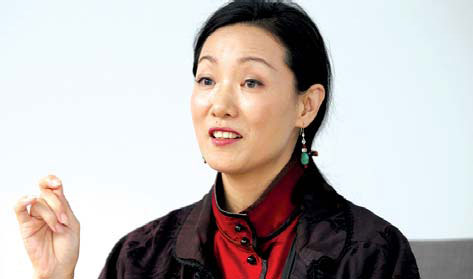
Wang Xinxin, founder of the Xinxin Nanguan Ensemble, strives to infuse traditional tunes with theatrical elements. Zou Hong / China Daily |
Those early days in her life moulded her passion for Nanyin music and made her appreciate the ancient art form, which she picked up at age 4. In the past decade, she has been trying to promote and innovate the genre to appeal to the younger generation.
Wang is in Beijing to participate in the Moma Post Mountain Music-Art Festival, performing traditional Nanyin music and her own creative music pieces.
While the festival's first year focused on rock music, this year's month-long festival, which kicked off on Oct 3, offers a variety of traditional music from around the world. Sophiline Arts Ensemble from Cambodia and Japanese shakuhachi flute player Yodo Kurahashi are all performing.
Sticking to the music styles of Nanyin, Wang has integrated Nanyin with Chinese classical poems and literature. One of her famous works, Sheng Sheng Man, adapted from the poem of Li Qingzhao, writer and poet of the Song Dynasty (960-1279), will be performed in her shows in Beijing.
Now in her 40s, Wang talks like her singing, softly and slowly. She says Nanyin music requires inner tranquility of both the audience and performers, which is like religious practice.
"The beauty of Nanyin music, like traditional Chinese ink painting and calligraphy, is about the blank space. When I pause for a second or two during the singing, I am still expressing my emotions and portraying the character," Wang says.
"It's simple yet sophisticated. You need to be patient and focused to enjoy Nanyin music."
With her mother as a pipa (a four-stringed Chinese lute) maker and her father a big fan of Nanyin, it is not surprising that she was among the first group of students to major in Nanyin at Fujian Art School in 1984.
She moved to Taiwan in 1992, where she began fusing the ancient music with other art genres, such as modern dance and symphony orchestras, and performed around the world.
In 2003, she founded Xinxin Nanguan Ensemble. In 2004, her album Nanguan Music and Poems from Tang Dynasty won the Golden Melody Award for the Best Ethnic Music Album.
The musician is also skilled in all four Nanyin instruments, namely pipa, xiao (the vertical flute), sanxian (long-necked lute), and erxian, (two-stringed instrument).
Renowned Taiwan choreographer Lin Hwai-min once said of Wang's performance: "When she begins to sing and play, we simply forget where we are."

Her improvisation of Nanyin music has received negative feedback from old Nanyin musicians, who said her performance departs from tradition.
She admits her performances contain lots of theatrical elements, such as lighting and stage design, which she feels is the only way Nanyin music can survive in the modern world.
Her next move is to popularize Nanyin as a form of music therapy. She is not aiming big, and hopes to appeal to those who can appreciate the music.
"Many people would sit there with their eyes closed. Though some of them cannot understand Fujian dialect, they can feel the mood, which is what I aim for," she says.
chennan@chinadaily.com.cn
(China Daily 10/11/2013 page18)