We have launched E-mail Alert service,subscribers can receive the latest catalogues free of charge

A Survey on the Transfer of Rural Land Use Rights in China
2015-10-21


 |
| A Survey on the Transfer of Rural Land Use Rights in China |
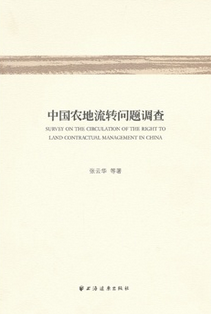
By Zhang Yunhua, Research Department of Rural Economy, DRC
The two-tiered system of unified management combined with independent farming, based on household contract responsibility system, is the basic management system in China's rural areas, as well as the cornerstone of the Party's rural policy. This system is in line with China's national conditions, the features of China's agricultural production and the demands of the Chinese farmers. Therefore, we must stick to this basic management system and keep improving it. The consolidation and improvement of the basic management system in rural China are related with three major theoretical and policy issues.
First, how to look at rural household management mode. Household management, with its superior compatibility, serves as the most fundamental mode of management in agricultural sector. It not only accommodates to hand-labor-based traditional farming, but also goes well with modern farming equipped with scientific and technological methods as well as advanced means of production. The practice that massive acreage of rural lands are leased out to industrial and commercial businesses for farming goes against the basic national conditions of a large population with limited land resources, and turning corporate entities into major players in agriculture and transforming farmers into agricultural workers are by no means the purpose of the reform for agricultural management system. Second, how to evaluate the two-tiered management system. Since reform and opening up, with further division of labor in rural areas, agricultural production, management and services have already gone beyond the previous collective farming. However, generally speaking, the unified management and service system of agriculture in China still fall short of the requirements of modern agriculture. Third, how to refine rural land system. At present, the institutional guarantee for farmers' rights and interests is still inappropriate such as imperfect land contract rights, insufficiency in basic rules and regulations concerning the rights and interests of farmers' homestead, an excessively wide scope for land requisition and low compensation for farmers with requisitioned lands.
This book draws a thorough conclusion on the progress and problems of the transfer of rural land-use rights in China, offers measures for improvement on relevant policies and sums up the history and international experience of the transfer of rural land-use rights. Based on case studies and field surveys, the author touches upon a series of major issues concerning the transfer of rural land-use rights in present China. The book consists of three parts. Part One gives an introduction to the transfer of land-use rights in China, including the current situation, problems and relevant international experience. Part Two covers some case analysis in terms of market condition, farmer's position, scale of management, management system and transfer price based on surveys conducted in provinces and municipalities such as Zhejiang, Chengdu, Heihe and Suzhou as well as home visits on rural households. Part Three is composed of three sections, namely, statistic analysis of questionnaires on farmers involved in the transfer of rural land-use rights, statistic analysis of village-based surveys and statistic analysis of questionnaires on land-renting by businesses.