We have launched E-mail Alert service,subscribers can receive the latest catalogues free of charge

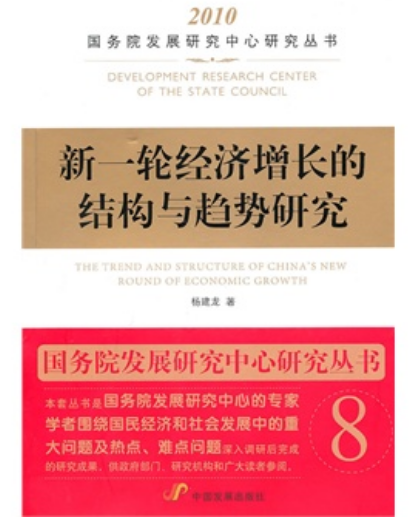
The Structure and Development Trend of a New Round of Economic Growth
2015-09-23


 |
| The Structure and Development Trend of a New Round of Economic Growth |
Yang Jianlong, Research Department of Industrial Economy, DRC
Since the turn of the 21st century, China's new round of consumption mix upgrading is phasing into a stage of rapid advance. Accompanied by this are crucial changes in mechanisms, structural features and cyclical characteristics for economic growth. On one hand, as China's economy has entered the middle-to-later period of industrialization, continuously high growth in investment and demand for energy and raw materials have imposed unprecedented pressure upon resources and environment; on the other, housing and transport demands have become the mid-and-long-term mainstay for fluctuations in the economic climate cycle, which generally present an obvious trend of fluctuation convergence, whereas short-term fluctuation margin widens due to eminent characteristics of heavy and chemical industries.
To meet the needs of theories and policy research for practical use, this book first makes a review and gives a summary of classic theories on economic growth and cycles, combines empirical research on structural features and cyclical features of China's new round of economic growth, and attempts to find a methodology framework that integrates issues of economic growth, economic cycles and the economic structure. This book serves as a specific manifestation of the report analysis method with the aim of basically accomplishing construction of "the analysis and prediction model for China's economic growth and structural changes".
Chapter 1 outlines primarily the methodology system of the research and puts forward an analysis framework from perspectives of theoretical review, leading industries, technological progress, comparative advantages and trade strategies. Chapter 2 thoroughly analyzes shifts of industrial patterns in different stages since the reform and opening-up and explains reasons for China's economic growth and cyclical fluctuations in this stage through the internal mechanism of industrial structural changes. Chapter 3 makes a further study on the new round of growth cycle since 2000 and conducts systematic research into features, mechanisms and cyclical effects of China's heavy and chemical industries. Chapter 4 systematically illustrates the research findings including relevant views and methodologies in the previous parts through quantitative empirical analysis and comparative analysis of China's input-output tables over the past three decades, and builds the quantitative analysis and prediction model of "China's economic growth and structural changes" based on the structural approach and input-output analysis. Chapter 5 focuses on analysis of key factors affecting China's economic growth in the next two decades. Chapter 6 makes quantitative prediction on leading forces for China's future growth from respectively the prospect of consumption demand growth (domestic demand), changes of comparative changes and the prospect of import and export growth (external demand). And Chapter 7 makes further systematic predictions on China's economic growth and structural changes as well as brief predictions on prospects of growth in automobile, real estate, machinery and other key industries.