|
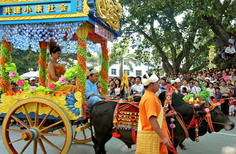
The Va ethnic group, with a population of 352,000, lives in Ximeng, Cangyuan, Menglian, Gengma, Lancang, Shuangjiang, Zhenkang and Yongde counties in southwestern Yunnan Province. Some are found scattered in the Xishuangbanna Dai Autonomous Prefecture and the Dehong Dai-Jingpo Autonomous Prefecture. Ximeng and Cangyuan counties are the main places where the Va people live in compact communities. In the areas where the Va people live, there are also Hans, Yis, Dais, Hanis, Lahus, Jingpos, Blangs, De'angs and Lisus.
|
|
| Va ethnic group |
Ximeng, Cangyuan, Menglian and Langcang are situated between the Lancang and Nu rivers, blocked by undulating mountain ridges some 2,000 meters above sea level. Traditionally this area was called the Ava hilly region.
With a subtropical climate, the fertile Ava region has plentiful rainfall and only 40 frost-free days a year. It is suitable for the growth of dry rice, paddy, maize, millet, buckwheat, potatoes, cotton, hemp, tobacco and sugarcane, as well as such subtropical fruits as bananas, pineapples, mangoes, papayas and oranges.
The Va language belongs to the Austroasiatic family. Before the founding of the People's Republic of China in 1949, except for some parts of the area where an alphabetic script was used, the Va people had no written language, and they kept records and accounting or passed messages with material objects or by engraving bamboo strips. Each strip ranged from half an inch to an inch in width. Objects used implied specific meaning or feelings. For instance, sugarcane, banana or salt meant friendship, hot pepper anger, feather urgency, and gunpowder and bullets the intention of clan warfare. An alphabetic script was created for the Va people in 1957.
Customs and Habits
The monogamous family was the basic unit of the Va society. Family property generally was inherited by the youngest son, while daughters were denied the right to inherit. A man was allowed to have more than one wife.
Men and women had sex freedom before marriage. Small groups of young men and women met and sang love songs. After giving their chosen partners betal nuts or tobacco leaves as a token of love, they could go to sleep together. Such freedom ended upon marriage. Marriages were arranged by parents, and the bridegrooms had to pay several cattle as betrothal gifts. Eloping used to take place as a result of forced marriages.
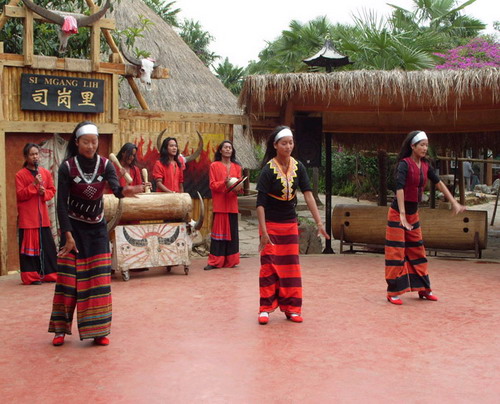
Most of the Va villages were built on hilltops or slopes. Some villages in the Ximeng area have a history of several hundred years and embrace 300 to 400 households. When a family built a new house, others came to help and presented timber and straw as gifts. Generally the house was completed in one day by collective effort. The "big house" of a big chieftain or a rich person was marked by a special woodcut on top. The walls were decorated with many cattle skulls still carrying horns. The other sections were the same as commoners' houses, built on stilts, and the space below was used for breeding domestic livestock. Before iron cauldrons were introduced into the area, the Vas used big bamboo tubes to cook rice, and the cooked rice was divided into equal shares by the hostess at the meal. They loved to chew betel nuts and drink liquor.
|