|
With a population of about 119,209 people (as of 1990), the Jingpo ethnic group shares land with the De'ang, Lisu, Achang and Han people. The Jingpo people are concentrated in the Dehong Dai-Jingpo Autonomous Prefecture in Yunnan Province in southeastern China. Some of the Jingpo people also live in the Nujiang Lisu Autonomous Prefecture.
The Jingpo people have their own language which belongs to the Tibeto-Burman Austronesian of the Chinese-Tibetan Phylum. Until 80 years ago, when an alphabetic system of writing based on Latin letters was introduced, the Jingpos kept records by notching wood or tying knots and calculation was done by counting beans; however, the new system of writing was not widely used. In 1957, with the help of the government, the Jingpo people started to use their improved Latin alphabetic system.
Historical records indicate that the ancestor of the Jingpo ethnic group has a close relationship with the Qiang and Dai people. They used to live in the southern mountain area of the Kang-Tibetan Plateau. Later, they gradually migrated to the northwestern Yunnan Province, west of the Nujiang River. During the Ming and Qing periods in the 15th to 16th century, aiming to avoid the warfare, they continue to move west and finally settled down in the Dehong area, living together with the De'ang, Achang, Lisu, Han and other nationalities. With the founding of the PRC in 1949, following consultation with the ethnic group, it was decided to agree upon the official name of Jingpo ethnic group.
Agriculture is the way of life for the Jingpo people, with rice and corn being the primary crops. Rice is the staple food, although maize is more important in some places. Jingpos also gather wild herbs and fruit as supplementary food.
Jingpo people are simple, bright zealous and brave. Jingpo men going out to hunt invariably wear long knives on their waist or take rifles with them. All carry elaborately-embroidered bags containing items such as areca and tobacco.
The Jingpos are also hospitable. Whenever a visitor comes, the master will present wine bottle and cigarette case to the visitor, saying please do us a favor. A guest should have everything and toast too.
The Jingpo people practice polytheism. Influenced by their primitive religion, the Jingpos are Animists, believing that everything in the nature has souls such as the sun, the moon, birds, beasts, fishes and all other living creatures. They also worship their ancestors, who they believe bring safety and prosperity to their offspring. Furthermore, some foreign religions, such as Christianity, are also practiced by a small number of the Jingpos.
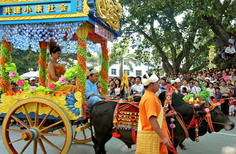
The most ceremonious festival of the Jingpo people is the Munao Festival. Muano is a large gathering intended to celebrate good harvests, to drive out evil spirits and to pray for happiness and success in cultivation and healthy crops to harvest. Munao means "minority singing and dancing" in the Jingpo language. The festival normally comes on the fifteenth day of the first lunar month and lasts two or three days.
|