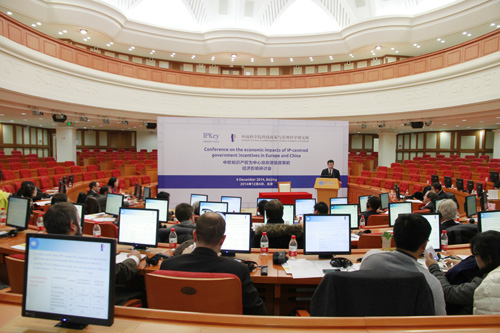
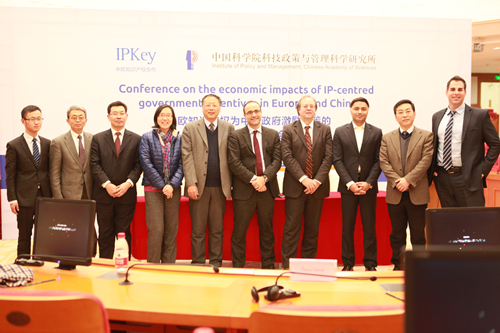
BEIJING, China - A type of policy instruments called "IP-centered government incentives" have emerged with increasing frequency in recent years in an attempt to encourage economic competitiveness, although their impacts have been under-researched, according to the proceedings of a conference held on December 4th 2014 at the Chinese Academy of Sciences Institute of Policy and Management (CAS IPM) in Beijing.
The conference, organized by the "IP Key" project, implemented by the Office for Harmonization in the Internal Market (OHIM) (the trademarks and designs office of Europe) and the European Patent Office (EPO) in partnership with CAS IPM, gathered experts from Europe and China to discuss the workings and impacts of such incentive schemes.
The conference discussed tax incentives, patent fee deductions, subsidies for patent-related fees, inventor remuneration schemes, industrial zone/geographic-area based schemes, among a range of other government schemes with intellectual property-related requirements.
"The effectiveness of these incentives to meet their objectives and the spillovers they may create are relatively underexplored, and thus more research is needed to ensure they are not having significant negative consequences," said Dan Prud’homme, Technical Expert at the IP Key Project.
"Some form of incentives are needed to ensure that China continues to increase its IP stock through 2020," said Professor Song Hefa, Deputy Director of the CAS IPM Centre for IPR Research and Training.
Other experts, like Professor Cheryl Xiaoning Long, Chair of the Department of Economics at Xiamen University, noted that "patent promoting policies" in China in particular have in some ways harmed the quality of patents, although have also clearly boosted the quantity of patents.
Vinod Kalloe, Head of International Tax Policy at KPMG Netherlands, noted that there has been surprisingly little research into the impacts of IP income tax policies in Europe, although some assessments are underway in light of increasing concerns that the programs are being used against their original intent.
The conference featured analyses of the impacts of a range of IP-centered government incentives in China, Italy, Germany, and several other European Union Member States. Other speakers included Federico Munari of University of Bologna; Chen Xiangdong of Beihang University; Liu Yun of the Beijing Institute of Technology; Zhang Xuecheng, Liu Haibo, Duan Yibing, and Zhang Yafeng of CAS IPM; and Johannes Holzer, acting independently, of the German Patent and Trade Mark Office.
The experts are collaborating on a set of policy recommendations, to be made available next year, for governments that have crafted or are considering crafting IP-centered government incentives.
(Source: IP Key)