Under the theme "new reform, new challenge, new opportunity", the fourth China Intellectual Property Annual Forum was held in Beijing on Jan 10.
Officials, scholars and industry insiders said the IP business has been developing rapidly in China in recent years, but continued innovation is still needed to help restructure industry and boost the economy.
Although the intellectual property is "an emerging academic subject in the law system and a new type of property in the field of economy", it has been never far from people's daily life, said Liu Chuntian, director of the Intellectual Property Institute of Renmin University of China and chairman of China Intellectual Property Law Association.
One example is that a cellphone contains more than 70,000 patents, he said.
"China is now in the transition from a developing nation to a more industrialized one," Liu said. "We can achieve that shift only by technical innovation and cultural creation."
As a tool of resource allocation, the intellectual property rights are different from traditional property rights because they contain value judgments, said Qu Sanqiang, the dean of Law School at Beijing Institute of Technology.
"To some extent, the intellectual property rights are legal fictions, and all legal fictions are subjective," he explained. "Because of that, IP laws vary in different countries and regions, as lawmakers inevitably implant their values and wills when they make IP laws."
"Before China joined the WTO in 2001, we mostly accepted the concept of intellectual property rights in a passive way, but today as the world's second-largest economy, we have a more active attitude," he added.
Zhang Xiaojin, presiding judge of the IP division in the Beijing Second Intermediate People's Court, said IP-related lawsuits have not only grown in number in the past few years but are also becoming increasingly diverse and complicated.
In 2009, there were some 30,000 IP-related civil lawsuits across the nation, she said. The number rose to more than 40,000 in 2010 and nearly 84,000 in 2012.
In addition to traditional forms of IP, including patents, trademarks and copyright, new fields are emerging, such as breeds of plants and online copyright, she said.
"The times are changing, and so are the markets, the environment and the people, but what has stayed unchanged is the demand for innovative capacity," said Qu Xiaoyang, the IP director of Siemens Ltd China.
"A company must have a clear understanding of the future trend," he said. "Then you will find ways to follow the trend via innovation. And when you are transferring innovation into productivity, you will realize the importance of intellectual property rights.
"A good IP strategy must cater to the company's marketing activities."
zhangzhao@chinadaily.com.cn
|
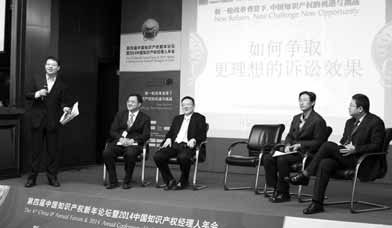
IP industry insiders share views at the annual forum. Provided to China Daily
|
(China Daily 01/15/2014 page17)