
Family planning policy sees big overhaul
Source:China Daily
Shan Juan
Updated: 2015-10-30


New initiative will actively address nation's aging problem, experts say
China further relaxed its more than three-decade-old family planning policy, according to a statement issued on Thursday by the Communist Party of China Central Committee.
Roughly 90 million Chinese couples will become eligible to have a second child.
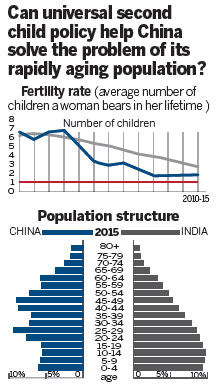
It's the latest move by the authorities to fine-tune the family planning policy, amid the nation's changing demo-graphics, which could lead to potential labor shortages in the future if not addressed.
The statement said the country's aging trend would be actively addressed by the universal two-child policy, and that China would continue to stick to the family planning policy as a basic State interest.
Yuan Xin, a population scientist at Nankai University in Tianjin, who sits on an expert panel of the National Health and Family Planning Commission, said scrapping the family planning policy remained a long way off.
"The new initiative will be much better received among the Chinese people than the previous policy relaxation and will help boost China's labor supply in the long run," he said.
In late 2013, the central government relaxed the family planning policy, allowing couples to have a second child in situations where one spouse was an only child. As of June, only 1.5 million of the 11 million eligible couples had applied to have a second child.
The latest change will affect rural families most, as 60 percent of the newly eligible are rural people who tend to be more interested than city dwellers in having bigger families, Yuan said.
Also, it's more urgent for the eligible couples, he said, as 60 percent of them are 35 years or older.
Yuan also suggested adding more favorable socioeconomic policies to make it easier for couples to raise more children. These primarily include improved reproductive and maternity care and easier access to infant nursing services and schooling, said a statement issued by the National Health and Family Planning Commission.
The universal two-child policy came at the right time, as the population growth trend has weakened and the size of the workforce is dwindling, the statement said. "It will help reverse the trend and sustain the nation's economic growth."
Official statistics show that China's potential workforce - people aged 16 to 59 - peaked around 2011, and has been in decline since then. At the same time, the number of working people has been falling as a proportion of the total population.
Last year, there were 916 million people between the ages of 16 and 59 in China, roughly 66 percent of the entire population. That peaked at 74.5 percent in 2010 and has been falling since.
At the same time, the ratio of children in the population has been dwindling, creating a potential future shortage of workers, said Mu Guangzong, a demographics expert at Peking University.
"The looming labor short-age will upset the sustainable socioeconomic development of the country," Mu warned. He suggested more aggressive approaches to reverse the trend and fuel population growth.
"China should end limits on family size thoroughly, and immediately implement a population revitalization initiative to encourage reproduction," he said.
Obstacles to childbearing include rising nursing and education costs, more women in the workforce, late marriage and the increasing number of single adults, experts said.
Contact the writer at shanjuan@chinadaily.com.cn
shanjuan@chinadaily.com.cn



World Family Summit
The World Family Organization was founded in Europe in 1947 and headquartered in Paris.


Link: / World Health Organization / United Nations Population Fund / UNICEF in China
Copyright 2014 National Health and Family Planning Commission of the PRC All rights reserved
