
New technology improves detection of lung disease
Source:China Daily
Wang Xiaodong in Wuhan
Updated: 2015-09-08


Early detection of lung disease in China is expected to greatly improve in a few years with the application of new technology, contributing to better prevention and treatment.
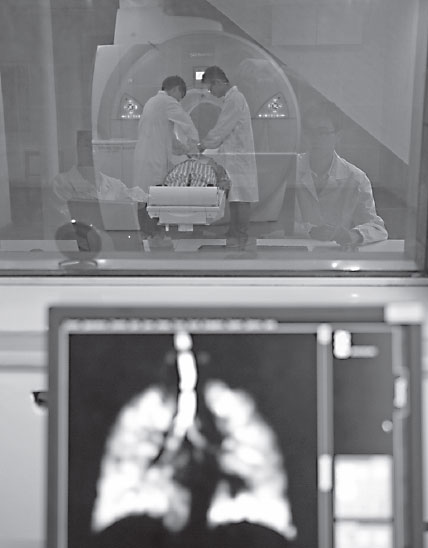
After five years of research, scientists at the Wuhan Institute of Physics and Mathematics at the Chinese Academy of Sciences obtained several clear images of human lungs displaying gas exchange functions - a vital indication of lung health - the first such images obtained in China.
"Compared with traditionally used lung-detection technologies such as computed tomography, the new technology can produce images with noninvasive and nonradioactive methods that visualize defects in the gas exchange function of lungs," said a statement released by the institute in Hubei province.
|
A patient undergoes a lung checkup at the Wuhan Institute of Physics and Mathematics at the Chinese Academy of Sciences on Sunday. Jin Liwang / Xinhua |
Currently, several methods have been adopted to detect lung disease, such as X-ray scanning, computed tomography and positron emission tomography, but those methods can only detect the structure of lungs and cannot obtain information on gas exchange in the lungs.
"When an abnormality is found with a lung's structure, its function has already been damaged," said Zhou Xin, a researcher at the Wuhan institute who led the project.
"The new technology can find damage or abnormality in functions, which might be hints of lung disease in the very early stage," he said.
The images are obtained through having patients breathe in the xenon-129 isotope, a kind of inert gas.
The gas is treated so it can be easily detected by magnetic resonance imaging scanners. Areas in the lungs that are filled with the gas will show in the image, while the areas where the gas fails to enter will be dark.
"A few other institutes and universities in some other countries such as the United States are also doing similar research, but the gas they use is mostly helium, which is more scarce," Zhou said.
Helium and xenon are the two most popular and reliable inert gases suitable for such operations due to their special physical natures, he said.
The project was started in 2010 with more than 60 scientists and doctors from the Wuhan Institute of Physics and Mathematics at the Chinese Academy of Sciences and Zhongnan Hospital of Wuhan University, and received more than 30 million yuan ($4.8 million) in funding from the central government, Zhou said.
Wu Guangyao, a doctor at Zhongnan Hospital who also participated in the program, said the images obtained by this technology are much clearer than those obtained by CT.
"If the technology is used clinically, it would benefit many patients with lung disease, since it could improve detection," he said.
wangxiaodong@chinadaily.com.cn
(China Daily 09/08/2015 page4)


World Family Summit
The World Family Organization was founded in Europe in 1947 and headquartered in Paris.


Link: / World Health Organization / United Nations Population Fund / UNICEF in China
Copyright 2014 National Health and Family Planning Commission of the PRC All rights reserved
