
Q&A About Middle East Respiratory Syndrome
Source: en.nhfpc.gov.cn
Updated: 2015-06-03


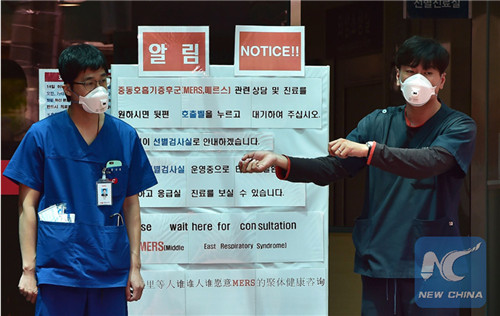
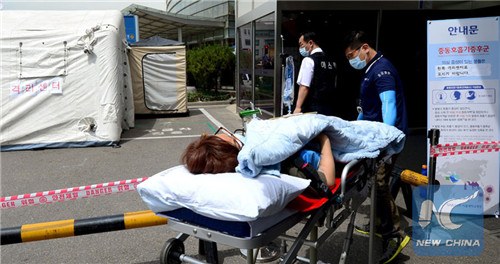
Hospital workers tend to a woman on a stretcher, who is believed to be infected with Middle East Respiratory Syndrome (MERS), in a quarantine area set up in a hospital in Seoul, South Korea, June 1, 2015. South Korea struggled to contain an outbreak of MERS on Monday as health authorities announced three more cases, bringing the number of infections to 18 in just over 10 days. (Xinhua/Reuters Photo)

South Korean hospital workers set a separated emergency center for MERS cases at the National Medical Center in Seoul on June 1, 2015. (Xinhua/AFP Photo)
Q: What's Middle East Respiratory Syndrome (MERS)?
A: MERS is a viral respiratory disease caused by MERS-CoV, a new coronavirus, first discovered in Saudi Arabia in 2012. The coronavirus is pathogenic to human and animal and often leads to a variety of diseases, from common cold to severe acute respiratory syndrome (SARS).
Q: Where have MERS occurred?
A: The following countries have reported MERS cases: Saudi Arabia, the United Arab Emirates, Jordan, Kuwait, Oman, Qatar and Yemen in the Middle East; Egypt and Tunisia in Africa; France, Germany, the Netherlands, Greece, Italy and the UK in Europe; the Philippines, Malaysia and Lebanon in Asia, and the United States.
The virus seems to be at large in the Arabian Peninsula. All recent cases reported outside can be traced back to the Middle East. Most infected travelers didn't seem to affect people in their own country. In 2013, only a few human-to-human transmissions of the diseases were found in France and the UK.
Q: What are the typical symptoms of MERS?
A: Typical symptoms often include fever, cough and shortness of breath. Patients often suffer from pneumonia. Diarrhea occurs in some cases. Severe cases can experience respiratory failure and need mechanical ventilation and supportive treatment in intensive care. Some patients could suffer organ failure, especially kidney failure and septic shock. The fatality rate is about 27 percent. The virus is likely to cause more serious disease to the elderly and those with low immunity and chronic diseases (such as diabetes, cancer, and chronic lung diseases).
Q: Will people be infected and not suffer attacks from the disease?
A: Yes. Some people didn't show any symptoms when infected. They were found carrying the coronavirus during follow-up studies of those having close contact with the patients.



World Family Summit
The World Family Organization was founded in Europe in 1947 and headquartered in Paris.


Link: / World Health Organization / United Nations Population Fund / UNICEF in China
Copyright 2014 National Health and Family Planning Commission of the PRC All rights reserved
