

 |
|
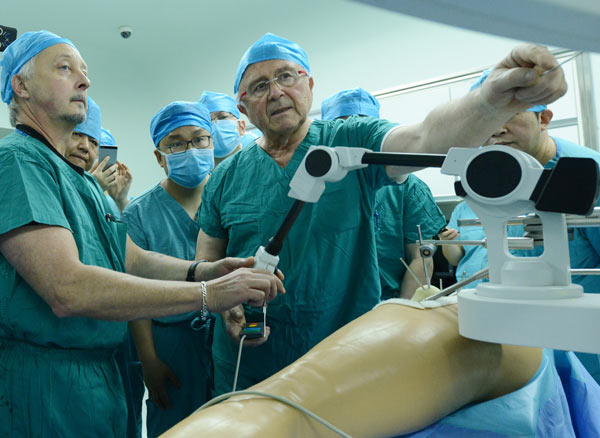
A doctor demonstrates how a robot conducts an orthopedic operation in Zhengzhou, Henan province. [Photo by Zhang Tao/For China Daily] |
Artificial intelligence technology will transform the medical sector and trigger an estimated 1 trillion yuan ($147 billion) market during the next 20 years.
A report from Firestone Inventing, a consultancy specializing in the medical industry and based in Hangzhou, showed that China is now one of the leading AI research and development centers along with the United States.
Last year, there were 144 Chinese AI companies involved in the medical sector. The majority of them were based in Beijing, Guangdong and the Yangtze River Delta.
"The era of AI is inevitable and has already been broadly applied to the healthcare area," said Dai Tao, deputy director of the Development Center for Medical Science and Technology at the National Health and Family Planning Commission in Beijing.
"For example, when AI is applied to the field of radiodiagnosis, it only takes five seconds for a computer tomography (CT)," he added. "Before, it would take up to half an hour."
Dai stressed that what is happening in the AI sector is just a glimpse of the future.
During the next two decades, artificial intelligence will radically change the healthcare industry and save lives.
"The government should strongly support the development of smart medical treatment, and promote the innovation of medical techniques," he said.
AI will also have a crucial role in the field of big data, a vital pillar of the information industry.
Medical big data is used to crunch vast amounts of complex statistics to show patterns and trends which are vital in healthcare.
Already doctors are using artificial intelligence systems to help them when dealing with patients.
"AI now is widely used in medical care," said Zhang Jiang, president of Ping An Ventures, a major investment company in Shanghai. "It helps doctors in diagnosing problems with patients."
"This not only lowers the service costs, but also improves the accuracy of the diagnosis," Zhang added.
The government has been encouraging the application of medical big data since 2015 as well as rolling out policies dealing with AI development in the healthcare industry.
The Ministry of Science and Technology, and the National Health and Family Planning Commission launched a blueprint to support medical innovation during the 13th Five-Year Plan (2016-20).
This involved guidelines on research in techniques in bioscience, precision medicine and medical AI.
Last year, Firestone Inventing revealed in its report that medical AI investment topped 2.58 billion yuan, which was a jump of 193 percent compared to the same period in 2015.
Major tech companies such as IBM, Google Inc, Microsoft Corp, Alibaba Group Holding Ltd and Tencent Holdings Ltd are all moving into the field of artificial intelligence.
In 2016, Baidu Inc launched its "Medical Brain" system, using AI to help doctors across China.
"Only 4.8 percent of the urban population go to see a doctor when they feel sick," said Fan Wei, director of Baidu's big data lab.
"Up to 89 percent of the online population search the internet for medical knowledge," Fan added. "Baidu Zhidao, the question and answer section on search engine Baidu, receives 10 million medical inquiries every day. So, the market for AI in the healthcare sector is huge."