 |
|
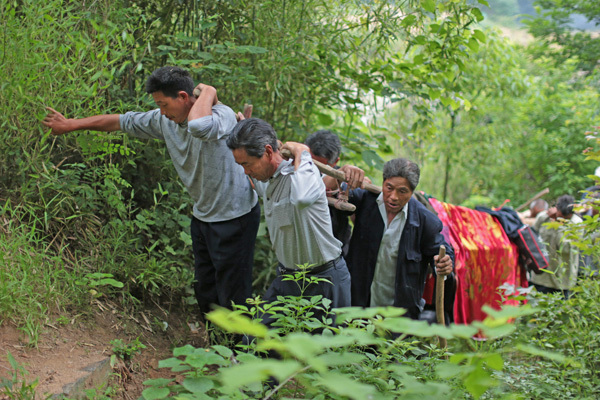
Family members carry a coffin containing the body of Zheng Shifang, 83, up a hill in Lyuting, a village in Anqing, Anhui province, on Sunday. Zheng hanged herself on May 23. New rules requiring cremation are scheduled to take effect on June 1. Chen Jie for China Daily
|
Authorities in Anqing, Anhui province, say there was no direct relationship between the alleged suicides of several elderly rural residents and the coming burial reforms that require corpses to be cremated.
The Oriental Morning Post in Shanghai published an article saying that six local elderly people committed suicide so their bodies could be buried legally in coffins.
Starting June 1, all corpses must be cremated, according to a notice from the Anqing government on March 25.
After the suicide allegations were published, Anhui provincial government investigated. It found that the deaths had nothing to do with funeral reform, according to an unnamed official with the civil affairs department.
"The newspaper's report is biased, as it cited no genuine facts, and some of the quotes are just the reporter's guesses," said an official surnamed Zhang from the Anqing publicity department.
One 27-year-old resident of a county-level city under Anqing, Yao Xuefei, said on Wednesday in a phone interview that he had not heard of an elderly person committing suicide because of the coming reform.
But resistance to forced cremations among some of the area's oldest residents, especially those in their 80s or 90s, is apparent, he said, adding that younger individuals have taken the reform with greater ease.
"Some of the elderly insist on being buried because of a deeply rooted superstition. It is still very hard to persuade them to accept new concepts," Yao said.
According to common funeral custom, a body should be buried several days after death. But in some villages, the corpse is laid in a coffin and placed in a shabby shed on a hill for at least three years before finally being buried. It is believed that the practice can bring good luck to the descendants of the deceased.
Yao has three family members in their 70s. Following the custom of many villages in Anqing, their coffins were prepared more than 10 years ago.
Residents invite carpenters to make their coffins, and when they are finished, relatives gather at the person's home for a celebration with gifts.
Yao's relatives destroyed their coffins under persuasion by local officials, which included compensation of 1,000 yuan ($160) for each coffin, earlier this year.
China has been encouraging cremation since the 1950s out of concern for land use, among other things. The national cremation rate reached nearly 50 percent in 2012.
The Anqing government announced funeral reforms in 1994 and 2006, but both failed because of tepid support from residents.
Local officials said that old burial customs need to be reformed, partly because some of them have had unexpected consequences.
For example, authorities say a fire that broke out in a forest park in Anqing on Jan 24, just before Spring Festival, may have been caused by locals' burning paper money as an offering to the dead, or by the lighting of firecrackers to honor deceased family members.
More than 20 officials in Anqing were punished after the fire for negligence. Some people speculated that this drove the authorities to adopt the funeral reform.
zhulixin@chinadaily.com.cn
|