|
Shihu is touted as being of therapeutic benefit, serving to strengthen the stomach and bones, replenish the kidneys, and prolong one's life span, Ye Jun reports.
Food as a health booster is a unique part of Chinese culture. Cantonese people often put herbs in their soups to benefit their body. Many people for instance, use pears to help with seasonal cough and dryness in autumn.
More effective herbs such as ginseng, which is often boiled in soup to replenish energy, has become rather expensive. But recently, experts from Yunnan's Longling county came to Beijing to introduce a more affordable local herb - shihu, the stem of the noble dendrobium.
|
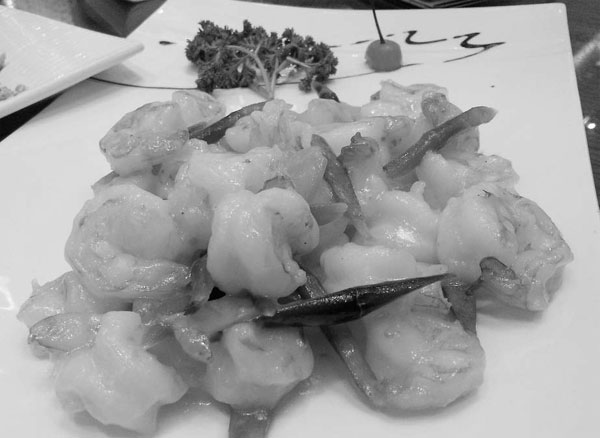
Fried prawns with shihu is a highlight in a feast featuring the herb from Yunnan's Longling county. Photos by Ye Jun / China Daily
|
Shihu is an orchid plant adnascent to trees such as pear or peach. It has beautiful flowers. The stem is used as a common herbal medicine. It has been used for more than 2,000 years in traditional Chinese medicine, according to the China Pharmaceutical Culture Society.
The Taoist Canon, a collection of Taoist literature from the Tang Dynasty (AD 618-907), refers to shihu as the first of nine "celestial herbs" with great health benefits. Some other herbs on the list include Tianshan mountain snow lotus; gingseng weighing 150 grams; lingzhi, i.e. ganoderma from remote mountains; pearl from the bottom of the sea; and winter worm summer herb, or Chinese caterpillar fungus.
The Compendium of Materia Medica, written in the Ming Dynasty (1368-1644) by Li Shizhen (1518-1593), says shihu can replenish weakness of the internal organs, boost the yin factor and benefit the minor particles of the body. To be more specific the herb "strengthens the stomach and intestines, replenishes the kidneys and strengthens the bones, makes one feel light-bodied and prolongs life span".
Bi Wengang, deputy director of the China Pharmaceutical Culture Society, says the herb works on three channels of energy - the stomach, the lungs, and the kidneys. At the same time, it has very light side effects and benefits the majority of people.
"Only those who have a very cool disposition (as described in TCM) should not eat it. They will feel cold when they eat it," he says. "But there are very few people like that."
Usually people will feel warmth in the stomach, and even in the legs after eating the herb.
Some old Chinese people know that shihu clears the vision.
China's Peking Opera master Mei Lanfang (1894-1961) was known to regularly drink water boiled with shihu to protect his throat and voice. Some other Peking Opera masters of his time did the same.
There are different kinds of shihu. Longling county produces a purple-peel variety. Anhui, Zhejiang and Fujian provinces produce shihu with iron-colored skin. Anhui's Huoshan county produces a Huoshan shihu. But these herbs have similar health functions.
At traditional Chinese medicine pharmacies, a dried roll of shihu is available for sale. It is called fengdou, dried shihu with iron-colored peel. The dried product is commonly used to boil with chicken, duck, or lamb, for general health benefits.
At Longling county's news conference, shihu herb is presented in different ways: The herb is squeezed into juice for drinking directly; the flower of shihu is made into a tea drink; and it is even brewed into a clear liquor with 38 percent alcohol.
Wang Youhong, a Chinese chef specializing in healthy recipes with Radegast Lake View Hotel, prepared a shihu feast for people who presented the event.
Fresh shihu stems can be chewed directly. It is rather tender, although there will be some remaining fiber after the chewing. Chef Wang cut the herb into slices and assorted it with seaweed and fungus to make tasty cold appetizers.
Shihu was boiled with ginseng to make a soup. After drinking it, many guests felt very warm in the belly shortly afterwards. The herb can be braised along with sea cucumber. But it tasted even better with braised lamb.
Wang even made a sweet drink with shihu juice and peach gum, which is believed to have a cosmetic function, especially for women. For men, it is not a bad-tasting dessert.
According to Liu Yong, deputy director of Longling Shihu Association, shihu is traditionally used in soups for people in Guangdong and Hong Kong, who have a habit of drinking them for health purposes.
"The herb is especially good because it nourishes but does not replenish directly," he says. Some replenishing herbs can be too strong for people with a weak physical condition. Shihu doesn't seem to pose that problem.
Wild shihu grown in nature is harvested from November to February. But it is planted in greenhouses and available all year round.
Liu says Longling now produces 2,500 tons of shihu a year. Last year the county sold 250 million yuan ($41.35 million) worth of the herb. Encouraged by that outcome the county is actively promoting its product around the country.
Depending on quality, home-grown shihu from Longling can cost around 300 yuan per kilogram. Wild varieties cost a lot more. It is available in specialized stores and Taobao.com.
Contact the writer at yejun@chinadaily.com.cn.
|
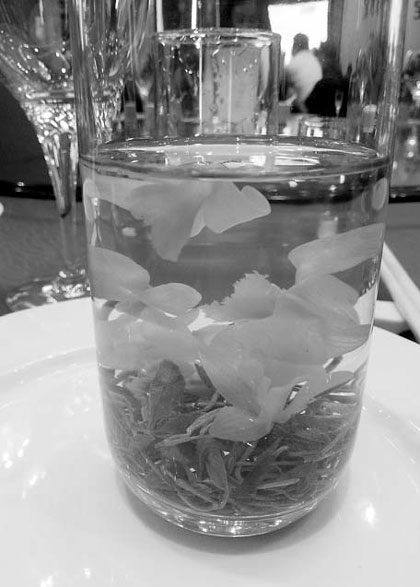
The shihu orchid is often infused in a herbal tea.
|
(China Daily 02/09/2014 page8)
|