|
In traditional Chinese culture, bamboo is a symbol of oriental beauty. It represents moral integrity, resistance, modesty and loyalty. For others, it means loneliness and elegance. This versatility has made it one of the major themes in Chinese paintings, calligraphy and poems. For thousands of years, generations of artists have praised bamboo, using it for carvings and designs.
Huizhou lies at the junction of three provinces--Anhui, Zhejiang and Jiangxi. With their charm and carved decorations, Huizhou's ancient architecture and artwork have received worldwide attention.
The traditional art of carved architectural decorations signifies the harmony between structural solidity and aesthetics. Craftsmen carve building parts accordingly, and the figures and colors are natural and proper.
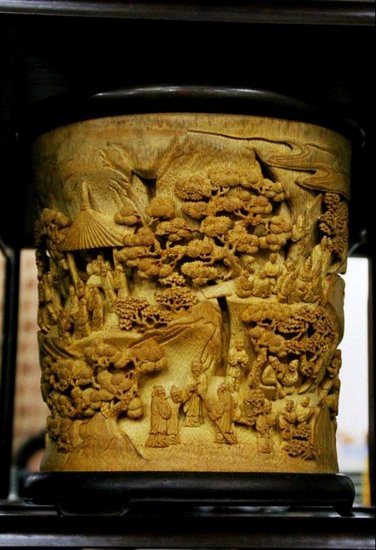
Bamboo carving, together with wood, stone and brick carving, are known as the four wonders of Huizhou carving. They are fresh and elegant—just like a Chinese painting.
Huizhou bamboo carving is an important part of Chinese bamboo art. It was after the mid-Ming Dynasty that bamboo carving gradually developed into an independent art form. Because bamboo carries the cultural connotations of moral integrity, seclusion and a person of honor, it was consistent with the psychological needs of the intelligentsia of that time. Thus, bamboo carving won their favor.
Now, several artisans in Huizhou have devoted themselves to bamboo carving to give this traditional handicraft a new lease on life.
Zhu Wei, who is in his thirties, operates a bamboo-carving workshop at the foot of Huang Mountain in Anhui Province. Although he has been a bamboo carver for more than a decade, he says he still has a long way to go before becoming a master carver.
'Our works have won gold medals in the National Tourism Products Competition and the Intangible Cultural Heritage Appraisal. Twenty years of learning and practice are necessary to become a master. I shall work harder.'
Zhu says carving a bamboo objects is not an easy job, as it requires several procedures. First, the craftsmen must draw a picture of the object and select the raw material. Three to five-year-old bamboo culms are preferred. The selected culms should be free of damage and cut from November to January when the moisture content of the bamboo is low.
Then the culms are dried vertically in the shade with ventilation, avoiding direct sunlight. The green bark must be removed from the surface of the bamboo, which is then treated with chemicals to prevent damage from fungus and insects. The culms are then boiled to drain the sugar.
Afterwards, craftsmen polish the surface of the bamboo and use a pencil to draw a carving pattern on the surface with a piece of duplicating paper. They use a sharp knife to shape the contour of the pattern, then a carving knife to express the relief of the carving. There are mainly two kinds of bamboo carving—surface carving, which exists in two forms: intaglio and undercut; and three-dimensional carving.
The final step is to complete the work with the right color, usually dark red or a coffee-like color. In Zhu's workshop, several craftsmen are busy carving and inscribing bamboo objects. Twenty-six-year-old Wu Yuming has worked here for eight years. He says his interest in bamboo carving prompted him to pursue a career in the craft.
'When I was a little child, I used to come to this workshop which was in the same neighborhood as my home, to watch the craftsmen do bamboo carving. I liked their works very much. I learned electronics as my major in college, but I decided to come back to learn bamboo carving after I graduated. Although I would earn more money if I found an electronics-related job, I never regret my decision because I really love this traditional culture. I will be very proud of myself if one day I can make really excellent bamboo carvings.'
This ancient Chinese cultural heritage has received a new lease on life thanks to the efforts of not only craftsmen, but also sociologists. Liu Kuili, a researcher at the Chinese Academy of Social Sciences, has committed himself to protecting China's intangible cultural heritage. He says bamboo-carving masters should add something more to this ancient craft to make it more suitable for modern life.
'Bamboo carving has a long history in China. The ancient sculptors absorbed skills from calligraphy and painting and created high-grade bamboo carving works. I think it's a good idea for craftsmen nowadays to create new themes. But one thing they should keep in mind is that bamboo has cultural connotations in China. Therefore, new themes must have some connections to Chinese traditions. I believe that the bamboo carving will have a bright future.'
In the past, every bamboo carving work has practical usage as well as artistic attainment. People nowadays regard bamboo carving as a sign of refinement to obtain bamboo objects made by master carvers only for decoration and appreciation.
With the passage of time and the development of architecture, bamboo carvings can still decorate modern homes. With their artistic charm and ancient essence, they provide a kind of edified and enlightened beauty.
 |
|
Bamboo carving, together with wood, stone and brick carving, are known as the four wonders of Huizhou carving. [Photo:qq.com]
|
(english.cri.cn)
|