


City weathers sanctions stress
 Mail
Mail Print
Print Larger
 |
|
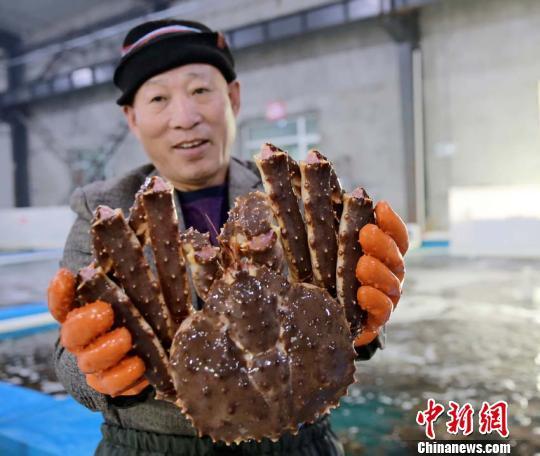
A man shows a crab imported from Russia, Hunchun, Jilin province. [Photo/chinanews.com] |
Drop-off in DPRK trade balanced out by growth in goods imported from Russia
After clearing customs at Hunchun, Jilin province, 12 trucks loaded with fresh king crabs from Russia carried on their journeys to the many companies in the city that trade in marine products.
One truck's destination was Yanbian Best Industrial Development, where CEO Wu Hanshan was waiting to inspect his cargo.
"These king crabs were offloaded at the Port of Zarubino in Russia just six hours ago, and now they're in China. Within 18 hours, they can be in Beijing," he said, as he lifted a crab weighing about 5 kilograms from a holding pond.
Hunchun, the only Chinese city that borders both Russia and the Democratic People's Republic of Korea, does not have a seaport but is only 63 kilometers from Zarubino in Russia's Far East.
As the volume of products shipped from the Russian port has significantly increased this year, especially timber and fresh marine products, it has become common for border inspection and customs officials in Hunchun to work overtime so that goods can enter China without delay, said He Yong, deputy director of the city's port management and development committee.
China's decision to launch its reform and opening-up policy in 1978 has transformed Hunchun, whose economy depends heavily on cross-border trade, and the surrounding Yanbian Korean autonomous prefecture.
"At the beginning of opening-up, Hunchun only had one land port, with the DPRK. Now it has two ports with the DPRK and two with Russia," He said. "The volume of goods passing through the ports is expected to reach 3 million metric tons this year, about 75 times that of the early 1990s."
In August and September last year, the UN Security Council imposed sanctions on the DPRK to exert economic pressure after the nation's missile test in July that year.
The sanctions banned the export of coal, iron, lead and seafood, and limited imports of crude oil and refined petroleum products. As a result, almost all cross-border trade between Hunchun and the DPRK has been halted, according to He.
The volume of goods passing through the ports with the DPRK in the first 10 months of this year dropped by more than 90 percent year-on-year, he said.
However, the sanctions did not halt construction of a new, larger inspection and customs building at the Quanhe port with DPRK, on the bank of the Tumen River.
Before the slowdown in trade, the old customs facility, in use since 2000, had been struggling to cope with the rising trade volume, said He, who added, "No matter what changes happen in the international environment, we need to be ready to facilitate opening-up."
While the sanctions still overshadow trade with the DPRK, the volume of goods passing through Hunchun's ports with Russia from January to October increased 13.3 percent year-on-year.
Wu's company also runs an iron ore mine in the DPRK. Operations were suspended after the UN sanctions took effect, and the company turned to importing marine products from Russia. "There is nothing we can do but wait and look for other business opportunities," Wu said.
Zarubino Port is expected to play a key role in the further reform and opening-up of the city and Northeast China, according to Zhang Liang, deputy director of Hunchun's marine affairs bureau.
"Besides using Zarubino to ship more goods from China to other countries, such as the Republic of Korea, we have also started to use it to ship goods to 14 ports in China," he said.
Now goods from Northeast China such as grain can leave Hunchun bound for Zarubino, where cargo ships can transport them to southern Chinese ports like Ningbo in Zhejiang province, saving transportation costs and time, Zhang said.
Poor infrastructure at the Russian port has limited its shipping capacity. To solve the problem, the Jilin government and Russia's Summa Group signed a cooperative agreement in 2014 to develop Zarubino Port, with upgrades expected to allow it to handle 60 million tons of cargo a year. Zhang said the port is expected to focus on grain, container traffic and alumina.
In July last year, China and Russia signed a memorandum of cooperation on two transport corridors, including the one connecting Hunchun and Zarubino.
Opening-up has also made Hunchun a popular tourist destination among Russians. Many shops in the city now have signs written in both Korean and Russian.
More Russians are coming to shop or seek medical care, according to bus driver Sun Mingyu, 40.
"I've witnessed how opening-up has gradually transformed the city and, more importantly, people's lives," he said. "It may sound like showing off, but now fresh king crab imported from Russia has become a common dish on Hunchun dinner tables at Spring Festival."

