


Scale of the challenge ahead remains unknown
 Mail
Mail Print
Print Larger
Identifying the scale of a problem can be the first step in finding a solution.
When it comes to autism in China, however, specialists warn that the actual number of individuals affected by the developmental disorder, which affects communication and social interaction, is still far higher than recorded figures.
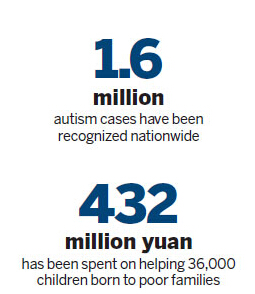
Health experts estimate that already more than 1.6 million cases have been recognized nationwide, while another 5 million at least are yet to be properly diagnosed.
For the parents of those diagnosed, the strain can be immense; it can destroy marriages and leave families with huge healthcare bills. Help has been coming, albeit slowly.
The China Disabled Persons' Federation began to channel financial and educational aid from the government to parents with autistic children in the 2000s. Today, those with children aged 3 to 6 receive an annual sum of 30,000 yuan ($4,800).
The central authorities also included autism in their 12th Five-Year Plan (2011-15), the first time the condition appeared in the country's all-important guide for national economic and social development.
Since then, autistic rehabilitation institutes have been made exempt from paying revenue tax, while the government has carried out a special plan to help impoverished parents of autistic children aged up to 6.
So far 432 million yuan has been spent on helping 36,000 children born to poor families, according to official figures.
Sun Zhongkai, executive director of the Beijing Stars and Rain Institute for Autism, predicted that the rise in reported cases of autism will gain more attention from the central authorities.
China Disabled Persons' Federation data show the country has established more than 100 rehab institutions for autistic children in recent years. However, many private centers are not registered, so the actual number is likely higher.
Many institutions are founded by parents directly affected by the condition, and are often small and poorly funded.
In 2012, the Shenzhen Autism Association took a survey for autism institutions nationwide with help from the One Foundation, an independent charitable body. It found most centers were short of government and financial support, and that there is a lack of professional teachers and medical care staff.
"Early behavioral, cognitive, or speech interventions can help children with autism gain self-care, social and communication skills," You Zhong, a member of Mental Health Association's Autism Committee at the federation, wrote in an article published last year. "Without training, they will have no work ability after reaching adulthood; some of them even display aggressive behavior that threatens social stability and safety."
Aid to autistic families is also important. In some developed countries and regions, the expenditure for autism-related special education is fully covered by government.
"In China, the financial aid for autistic teenagers or adults is almost blank," You wrote. "It is not a rare disease, and should not be seen as one."
Sun at Beijing Stars and Rain added that, due to a lack of awareness and knowledge, many children are missing the best time for therapy, which is before the age of 3.
"One needs a lot of material to diagnose autism and draft a plan for recovery," Sun said. "That's impossible in China because specialized doctors are rare."
They are overworked, too. At Peking University Sixth Hospital, one of the few institutions with medics specializing in autism, doctors on average deal with more than 50 patients every morning, meaning they hardly have more than five minutes for each.
Plus, China does not have a general methodology for screening autistic children nor for developmental intervention, according to Kuang Guifang, director of psychology at Qingdao Children's Hospital and an expert on the condition.
Sun and his colleagues have launched a campaign to start a nationwide screening of infants, a practice common in developed countries, to diagnose autism as early as possible, so that more children can have a chance to catch up with their peers through expert help and training.
What they hope for is not just more government funding, but society's joint efforts.

