LIFE> Travel Guides

|
LIFE> Travel Guides
|
|
Humble origins of a 500-year-old garden paradise
By Zhou Furong and Yang Cheng (China Daily)
Updated: 2009-06-24 16:32
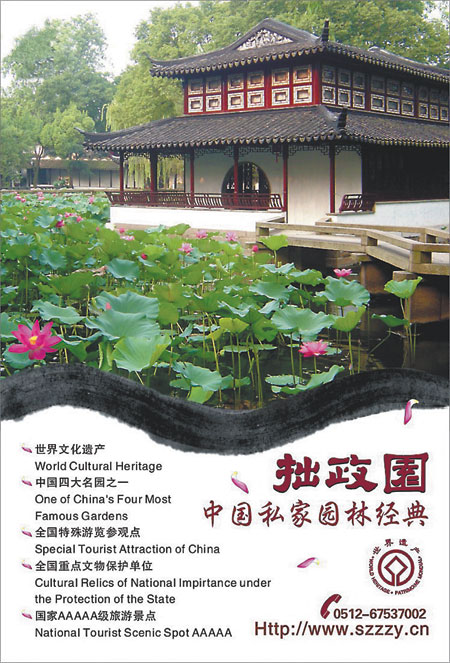
Also known as the Zhuozheng Garden, it has long been rightly praised as the most elegantly classical garden south of the Yangtze River and a true pearl of eastern China’s Jiangsu province. Despite its unique design and ethereal beauty, it is only during the last 50 years that it has been truly recognized as one of China’s outstanding natural enclaves. The last half-century, though, has seen it gain astonishing global recognition, a latter-day compensation for the centuries it was all but unknown beyond its own leafy perimeters. nIn 1961 it was designated as one of the sites featuring Cultural Relics of National Importance to be placed under the Protection of the State. nIn 1991 it was named as a Special China Tourist Attraction by the National Planning Commission (then the National Development and Reform Commission), the Ministry of Construction and the National Tourism Administration (NTA). nEvery year, since 1996, annual azalea and lotus festivals have been held in the gardens, in spring and summer respectively. nIn 1997 it was listed as a World Cultural Heritage site. nIn 2007 the NTA acknowledged the site among the first “5A” designated tourist spots in China. Belying its sudden rush of modern acclaim, the history of the Humble Administrator’s Garden stretches back almost exactly 500 years to 1509 and the days of the Ming Dynasty (1368-1644). Originally conceived as a private garden by Wang Xianchen, a late civil servant, it was intended as a quiet retreat for the one-time official to live out his retirement years. It derived its original name from Wang’s avowed intention to live out his remaining years humbly, tending his garden and growing vegetables — appropriate tasks for the “humble” man he aspired to be. From its humble beginnings, it later passed into more affluent ownership. In 1631, during the reign of the Emperor Chongzhen, the east section of the garden was owned by Wang Xinyi, a senior government official, while the remainder was divided up between a number of minor nobles. 1860 saw a drastic change of allegiance for the gardens which then fell under the auspices of the Taiping Revolutionary Force, a rebel band determined to de-throne the then Emperor, Xianfeng of the Qing Dynasty (1644-1911). In 1877 more bucolic pastimes prevailed and the western part of the gardens came under the ownership of Zhang Luqian, a businessman who renamed the gardens as the “Bu” (or “Mending”) Garden. After 1949 and the founding of the People’s Republic of China, the gardens were placed under the protection of the central and local governments. They were first opened to the public in 1952. Today, at it was half a millennium ago, the garden is dominated by its striking water features, while its 52,000 sq m of unspoilt landscape is still home to the miniature forests, gentle hills and unique rock formations that delighted its original humble owner. However, it is not without some testimonies to the passing centuries. As well as its original natural attractions, it is now dotted with a number of man-made pavilions, halls and parlors, the remnants of the residences of many of its former owners. Famous “must-see” spots in the garden include the Cymbidium Goeingii Hall (Lanxiang Tang), the Celestial Spring Pavilion (Tianquan Ting), the Hall of Distant Fragrance (Yuanxiang Tang), the Small Flying Rainbow Bridge (Xiaofeihong), the Mandarin Duck’s Hall (Saliu Yuanyang Guan), an octagonal pagoda-style Reflecting Pavilion (Taying Ting), a Bonsai Garden (Penjing Yuan), and the Elegant Stone House (Yashi Zhai). By Zhou Furong and Yang Cheng
 |
麻城市| 鸡西市| 大同市| 穆棱市| 女性| 蒲城县| 崇左市| 长葛市| 盘山县| 尼玛县| 罗田县| 平谷区| 稻城县| 宁武县| 神木县| 红安县| 玛纳斯县| 思南县| 政和县| 西宁市| 蓬莱市| 福海县| 莱阳市| 堆龙德庆县| 朝阳区| 邹城市| 和田县| 伊金霍洛旗| 阿拉善盟| 大足县| 巴马| 清流县| 宜良县| 兴隆县| 灵宝市| 金堂县| 沁源县| 常熟市| 西华县| 江安县| 剑川县|
