Comments
  Print
Print  Mail
Mail  Large Medium Small
 |
|
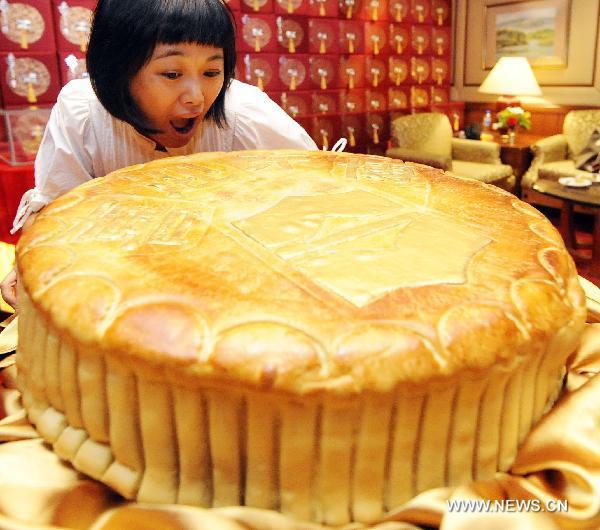
A citizen is attracted by a huge mooncake at Changchun Shangri-la Hotel, northeast China's Jilin province, on Aug 31, 2010. Mooncake manufacturers have waged wars on the market more than 20 days before the traditional Mid-Autumn Day. [Photo/Xinhua] |
BEIJING -- The Mid-Autumn Festival, which falls on Sept 12?this year, is a traditional Chinese holiday that originates from worship of the moon.
As its name suggests, the day falls in the middle of the fall season and symbolizes harvest and family reunions.
The festival, celebrated in the 15th day of the eighth month in the Chinese calendar, has no fixed date in the Western calendar, but the day always coincides with a full moon. It is also known as the Moon Festival.
Descriptions of the "Mid-Autumn" first appeared in "Rites of the Zhou", a collection of ritual matters of the Western Zhou Dynasty some 3,000 years ago. It described the eighth lunar month, the second month of autumn, as "mid autumn."
The Chinese began celebrating the Mid-Autumn Festival in the early Tang Dynasty (618 - 907), a period of material abundance and cultural blossoming.
The Chinese worshipped the moon by offering liquor, fruit and snacks outdoors, expressing thanks for bumper harvest and praying for the god of the moon to bring good luck.
The Temple of the Moon, or Yuetan, in downtown Beijing is where emperors of the Ming (1368-1644) and Qing (1644-1911) dynasties worshipped the moon.
The festival is considered an important Chinese holiday, next only to the Spring Festival, or the Chinese New Year.
The Chinese government listed the festival as intangible cultural heritage in 2006. It was made a public holiday in 2008.
The Mid-Autumn Festival is characterized by:
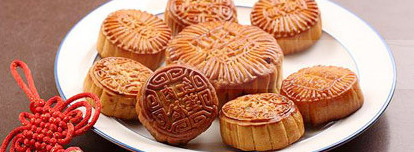
Mooncakes: A legend goes that mooncakes were first made in the 14th Century, when people exchanged pancakes that were stuck with slips of paper reading "Kill the Mongols on the 15th day of the eighth month". It was said to be a secret message from rebel leader Zhu Yuanzhang calling on the Chinese to overthrow the Mongolian rulers of the Yuan Dynasty (1279-1368)
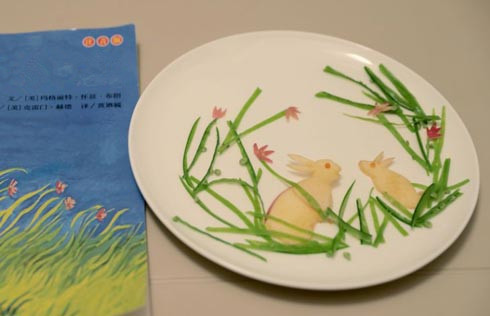
Lord Rabbit: Known as Tu'er Ye in Chinese, the Lord Rabbit is a traditional icon of the festival. It has a human body, but a rabbit's ears and mouth.
Matchmaking: The Chinese believe the god of the moon is a highly efficient matchmaker. In some parts of China, masquerades are held on the Mid-Autumn Festival for young men and women to find partners. One by one, young women are encouraged to throw their handkerchiefs to the crowd. The young man who catches and returns the handkerchief has a chance of romance.
Lanterns and dragon dances: These are traditional activities during the holiday, but are popular mainly in south China, particularly in Guangdong Province and Hong Kong.

 Paintings feature the natural beauty of Beijing
 Peking Opera inherited in primary school
 What's on in Beijing (Nov 18-24)
 Young people continue the art of 'painting with fire'


Copyright 1995 - . All rights reserved. The content (including but not limited to text, photo, multimedia information, etc) published in this site belongs to China Daily Information Co (CDIC). Without written authorization from CDIC, such content shall not be republished or used in any form. Note: Browsers with 1024*768 or higher resolution are suggested for this site.
License for publishing multimedia online 0108263 Registration Number: 20100000002731